Practical
Costa Rica Car Rental Insurance: Why the Quote Isn’t the Price
Guanacaste Experiences editorial team
·
23 September 2026
·
7 min read
In this guide
What the law actually requiresWhat it actually costsWhy the cheap quotes are not lying, exactlyThe “full coverage” trapWho quotes the real priceHow to not get caughtDo you even need the car?Questions people askSearch for a rental car in Costa Rica and you will find eye-catching daily rates. Arrive at the Liberia counter and the bill is often two or three times what you were quoted. This is not a scam by a rogue operator — it is a structural mismatch between how Costa Rican rentals are priced and how comparison sites display them, and almost everyone hits it once.
Here is what the law actually requires, what it costs, and how to get a quote that matches the final bill.
The one-line version
Costa Rican law requires liability insurance on every rental. You cannot decline it, and your credit card’s coverage does not satisfy it. It costs roughly $11–25 per day, and most online quotes leave it out entirely. Budget for it before you compare prices, not after.
What the law actually requires
The mandatory cover is third-party liability — the part that pays for damage you do to other people and their property, not to your rental car. You will see it written as TPL, SLI, PLI or *responsabilidad civil*, depending on which company is talking.
It rests on a Costa Rican instrument called the SOA — *Seguro Obligatorio de Automóviles*. The mandatory minimum is roughly ₡6 million, about US$10,000 per accident. That is the floor, not generous coverage, which is why rental companies sell products on top of it with higher limits.
Two consequences catch visitors out:
You cannot decline it. Unlike the collision damage waiver, which you can refuse if you have your own cover, liability is a condition of renting the vehicle at all.
Your credit card does not count. Card-issued rental cover is almost always collision and theft, not third-party liability — and Costa Rican counters do not accept it in place of the local policy. Neither, as we will get to, do they accept liability products sold by booking websites.
What it actually costs
Companies that publish their liability rates put it in a narrow band. These are the operators’ own published figures, not estimates:
Published daily liability-insurance rates, from each company’s own site. Read as of September 2026; rates change.
Company
Published daily rate
Notes
Poas Rent a Car
$12 – $20
Varies by vehicle category; $2,000 security deposit
Vamos Rent-A-Car
$15.95 – $17.95
Sedan to full-size, then premium
Europcar Costa Rica
$19.99 + tax
Their TPL product covers up to $5,000
Across the market the working range is $11 to $25 a day. On a ten-day trip that is $110 to $250 that a quote may not have shown you — frequently more than the advertised cost of the car itself.
Why the cheap quotes are not lying, exactly
The reason comparison sites show a price that cannot be paid is mechanical rather than sinister: rental companies do not pass the mandatory coverage price through to the booking platforms. The platform shows you the car, the taxes and its own fees, because that is all it has been given. The liability line is added locally, at the counter, in Costa Rica.
Vamos puts the consequence bluntly on its own site: booking portals such as Expedia, Kayak and Priceline decline any responsibility for undisclosed taxes or charges a local rental company may add on arrival. That is not a complaint about those companies so much as a description of where the liability for the gap sits — with you.
The “full coverage” trap
Several booking sites sell their own insurance product at checkout, often called full coverage or full protection. Read what it is before you rely on it, because two things are commonly misunderstood.
First, these are usually reimbursement products. You still pay the rental company at the counter, then claim the money back afterwards. They are not a waiver handed over at the desk, and they do not remove the charge from your bill.
Second — and this is the part that surprises people — Costa Rican counters may not accept them at all. Europcar Costa Rica states it on its own insurance page, in plain terms:
Liability Insurance Products purchased on third party travel websites are not accepted in Costa Rica.
— Europcar Costa Rica, insurance and coverage options
So it is possible to buy liability cover online, be charged for local liability cover again at the counter, and end up claiming back the first one. That is the worst version of this, and it is avoidable.
Who quotes the real price
A handful of Costa Rican operators price all-in deliberately, and say so in their own words. Adobe Rent a Car is the clearest: it states that it automatically includes all mandatory fees in its quotations, and that *“we quote absolutely everything that’s mandatory, this way the client knows exactly how much the final price is going to be.”* Vamos publishes its liability rates openly rather than revealing them at the desk. Jumbo Car states that basic third-party liability is always included in its rates.
We are not being paid to name those three — at the time of writing we have no commercial relationship with any of them. They are simply the ones whose published pricing position we could verify from their own pages.
Be careful with brand-level claims, though. Some international brands market Costa Rica as “all-inclusive” on their European sites while their Costa Rican franchise terms require liability to be purchased at the counter. Costa Rica is a franchise market for most global rental brands, and the franchise sets the local terms.
How to not get caught
Get the total, in writing, before you fly. Ask for a quote that includes mandatory liability. If a company will not give you one, that is your answer.
If you book through a comparison site, read the “rate includes” line on the specific offer — not the headline price, and not the site’s general reassurance. Coverage varies by supplier and, on some platforms, by the country of residence you entered.
Do not buy liability from the booking site unless you have confirmed the counter will accept it. Collision and theft products are a different question.
Budget $11–25 a day on top of the car, and compare totals rather than headline rates. The cheapest headline is frequently not the cheapest total.
Expect a deposit hold on a credit card — Poas publishes $2,000. Debit cards are often refused.
Do you even need the car?
Once the real cost is on the table, the question changes. A rental at $40 a day plus $18 of liability is roughly $58 a day, or about $580 for ten days before fuel. Two airport transfers and a handful of tour pickups can come in well under that — and in Guanacaste most tours include hotel pickup anyway.
The car earns its cost when you plan to move between beaches on your own schedule, or reach places that shuttles serve badly. It earns very little if you are based in one town and taking guided trips. Our getting around Guanacaste guide works through that trade-off, and the LIR versus SJO comparison covers which airport suits which plan.
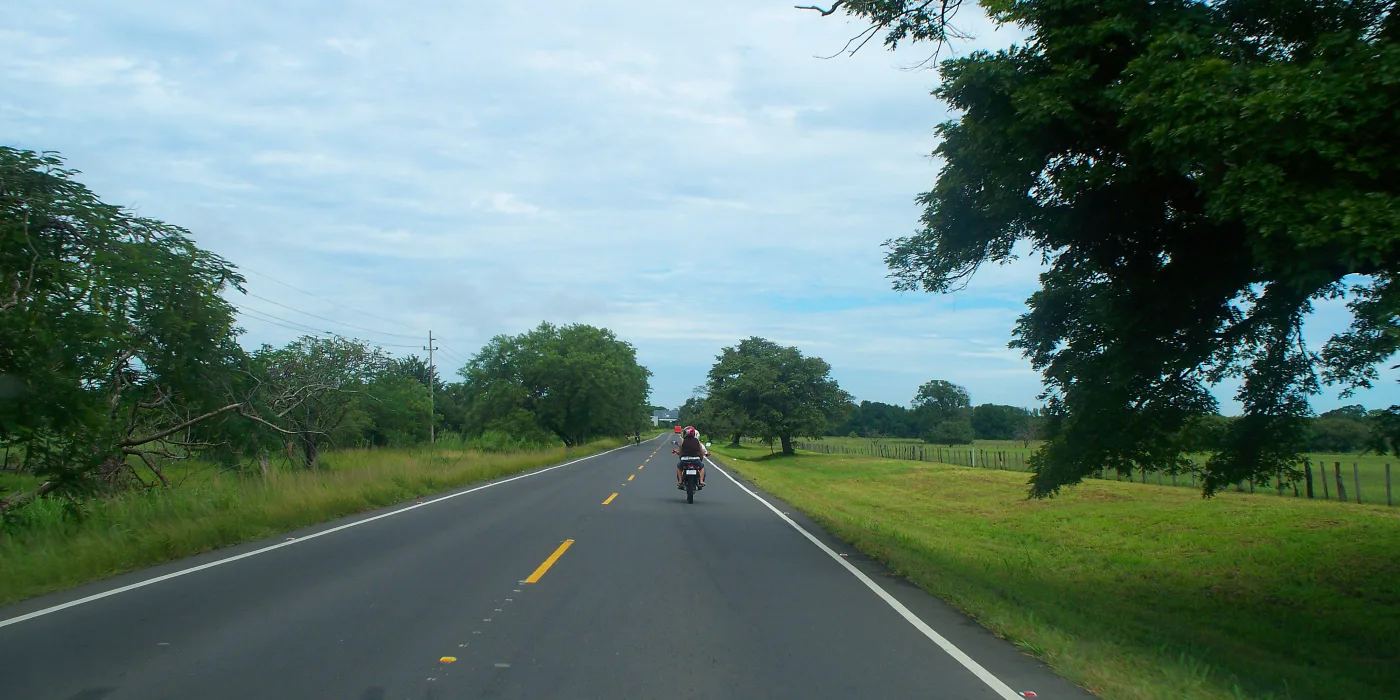
If you do drive, two practical notes. Many beach and peninsula roads are unpaved, so a higher-clearance vehicle is sensible — though note that even for the gravel approach to Palo Verde National Park, SINAC says a 4x4 is *preferable*, not required. And the UK foreign office warns that in the June-to-November rainy season, heavy rain causes potholes and landslides that block roads, with bridges often narrowing to a single lane. Drive in daylight where you can.
Questions people ask
Is car rental insurance really mandatory in Costa Rica?
The third-party liability portion is, yes. It rests on the SOA (Seguro Obligatorio de Automóviles), whose mandatory minimum is about ₡6 million, roughly US$10,000 per accident. You cannot decline it. The collision damage waiver is a separate product and can usually be declined if you have your own cover.
Does my credit card cover it?
Almost certainly not. Card-issued rental cover is normally collision and theft, not third-party liability, and Costa Rican counters do not accept it in place of the local policy. Check your card’s terms by all means — but assume you are paying for liability locally.
How much should I budget?
Between $11 and $25 per day on top of the car. Published examples: Poas $12–20, Vamos $15.95–17.95, Europcar $19.99 plus tax. On a ten-day trip that is $110–250 beyond the advertised rate.
Can I buy the insurance online to save money?
Be careful. Liability products sold by booking websites are not always accepted at Costa Rican counters — Europcar Costa Rica states outright that they are not. Many are also reimbursement products, meaning you pay the rental company anyway and claim back later. Confirm with the actual supplier before relying on one.
Do I need a 4x4 in Guanacaste?
Often useful, rarely mandatory. Many beach and peninsula roads are unpaved and rougher in the green season, so higher clearance helps. For the gravel road into Palo Verde, SINAC itself says a 4x4 is preferable rather than required. Size the vehicle to the roads you actually plan to drive.
Why is the quoted price so different from the final price?
Because rental companies do not pass the mandatory liability price through to comparison sites. The platform shows the car, taxes and its own fees — the liability line is added locally at the counter. Nothing is hidden from the platform’s side; it simply was not given the number.
Sources
Facts in this guide were checked against these references on the dates shown.
Jumbo Car Costa Rica — Car insurance in Costa Rica — The mandatory minimum coverage provided through the SOA (Seguro Obligatorio de Automóviles) is 6 million colones, approximately USD 10,000 per accident; Costa Rican law requires visitors renting cars to purchase liability coverage; the company states that basic third-party liability is always included in its own rates. (accessed 23 September 2026)
Europcar Costa Rica — Insurance and coverage options — Third-party liability insurance “must be paid in addition to the amount of the daily rent of the vehicle, unless the rate expressly mentions that it is included”; their TPL product costs $19.99 plus tax per day and covers up to $5,000; and “Liability Insurance Products purchased on third party travel websites are not accepted in Costa Rica.” (accessed 23 September 2026)
Vamos Rent-A-Car — Rental quotes exposed — Costa Rica requires every rental vehicle to be insured against third-party claims and this is a mandatory policy; expect to pay between $11 and $25 per day depending on the make and model; booking portals such as Expedia, Kayak and Priceline decline responsibility for undisclosed taxes or charges a local rental company may add on arrival. Vamos publishes its own TPL at $15.95 per day for sedan to full-size and $17.95 for premium. (accessed 23 September 2026)
Adobe Rent a Car — Hidden fees — Adobe states that it automatically includes all mandatory fees in its quotations, and that “we quote absolutely everything that’s mandatory, this way the client knows exactly how much the final price is going to be”. (accessed 23 September 2026)
Poas Rent a Car — Insurance — TPL coverage is mandatory in Costa Rica and, if alternate coverage cannot be validated, acceptance of TPL is a condition of rental; the company lists TPL at USD 12–20 per day depending on vehicle category, alongside a USD 2,000 security deposit. (accessed 23 September 2026)
Discover Cars — Help centre, liability coverage by region — Discover Cars states that third-party liability is usually standard and already included in the rate in Europe, but that in the United States, Canada and parts of South America basic liability limits can be lower or sometimes excluded; their “Full Coverage” product is a reimbursement product under which the customer pays the rental company first and claims back afterwards, rather than a waiver issued at the counter. (accessed 23 September 2026)
UK Foreign, Commonwealth & Development Office — Costa Rica travel advice — Road conditions are generally good on main routes, but in the rainy season heavy rain causes potholes and landslides that block roads; June to November is the peak rainy season, when flooding and landslides may cause road closures and driving hazards; bridges often narrow the road to a single lane. (accessed 23 September 2026)
SINAC — Parque Nacional Palo Verde, recommendations — For the gravel approach road to Palo Verde, SINAC states that in the rainy season a 4x4 vehicle is preferable because of road conditions — preferable rather than required. (accessed 23 September 2026)
Plan this trip
Browse the tours that fit what you’ve just read — real operators, real prices, book direct.
Getting around Guanacaste