Destinations
The Best Day Trips from Santa Teresa & Mal País, Costa Rica
Guanacaste Experiences editorial team
·
23 September 2026
·
16 min read
Hero photo: Hans Hillewaert / Wikimedia Commons (CC BY-SA 3.0)
In this guide
Day trips from Santa Teresa at a glanceFirst, the 4x4 question — because it decides your budgetCabo Blanco: the trip that justifies the driveMontezuma and its waterfall: read this part before you goIsla Tortuga: the full day that actually worksCurú: the one that repays a slow morningJacó by boat: the trip that makes no sense by roadWhat does not work from Santa TeresaGetting here, and the ferryQuestions people askSanta Teresa is a long way from almost everything, which is the point. What people rarely mention is how much sits inside forty minutes of it. Costa Rica’s most famous piece of conservation history is down the road past Cabuya. A boat leaves for an island most visitors reach from the far side of the gulf. A waterfall, a wildlife refuge, and a fishing village with a ferry terminal are all closer than the nearest supermarket town of any size.
The catch is that the peninsula is merciless to anyone who plans from a map. Places that look like an hour away are five. The reserve worth the drive is closed two days a week and takes no bookings. One refuge refuses cash and another may not take your card. This guide sorts what is genuinely reachable, and is specific about where the risks and the closures actually are.
About the drive times
Local times below are one way from Santa Teresa, without stops, based on OpenStreetMap routing. For anything beyond Paquera we use the shuttle operators’ own published times instead, because routing engines send you along the unpaved coastal road and return figures less than half what operators quote. That gap is not a rounding error — it is the single most common way visitors here misjudge a day. Times also depend heavily on traffic, the day of the week and the season, so treat them as a floor and add a margin between May and November.
Day trips from Santa Teresa at a glance
Times are one way from Santa Teresa. Local figures are free-flow routing estimates; anything over two hours is the shuttle operators’ own published time.
Trip
Time each way
Worth it for
Verdict
Playa Carmen
About 3 min
Sunset, dinner, the surf break
Walkable, barely a trip
Mal País
About 15–20 min
A quieter beach and the fishing cove
Do it on a whim
Cóbano
About 25–30 min
The bank, the clinic, real groceries
Errands, not sightseeing
Cabuya
About 40 min
A low-tide walk to the island cemetery
Pair it with Cabo Blanco
Cabo Blanco
About 40 min
Costa Rica’s oldest reserve, and a beach at the end of it
The headline trip — but check the day
Montezuma and the waterfall
About 40 min
A town, a beach, and the falls
Read the safety section first
Isla Tortuga
8–9 hr round trip
Clear water and snorkelling
A full day, and genuinely a day trip
Curú
About 1 hr 15
Monkeys, deer, and the quietest beaches nearby
Bring a card, not cash
Tambor
About 1 hr
The airstrip and a calm bay
Mostly a transit stop
Jacó
8:30am boat only
A different coast entirely
Possible by sea, absurd by road
Nicoya
2 hr 30 – 3 hr
The nearest proper town
A long errand
Sámara / Nosara / Tamarindo
4½ – 6 hr
Other beaches
Not a day trip. See below
First, the 4x4 question — because it decides your budget
You will read everywhere that Santa Teresa demands a 4x4. We went looking for an official source saying so, and could not find one. Not MOPT, not CONAVI, not the LANAMME road laboratory, not the tourism board, not the Cóbano district council. The recommendation is repeated almost entirely by travel sites and by car rental companies, who sell the upgrade.
What the government inventory does say is more useful. The main approach — the ferry at Paquera, then Tambor, then Cóbano on Ruta 160 — is 33.66 km of continuous asphalt, and the final stretch into Cóbano is rated as a generally smooth surface. That is an ordinary car’s road.
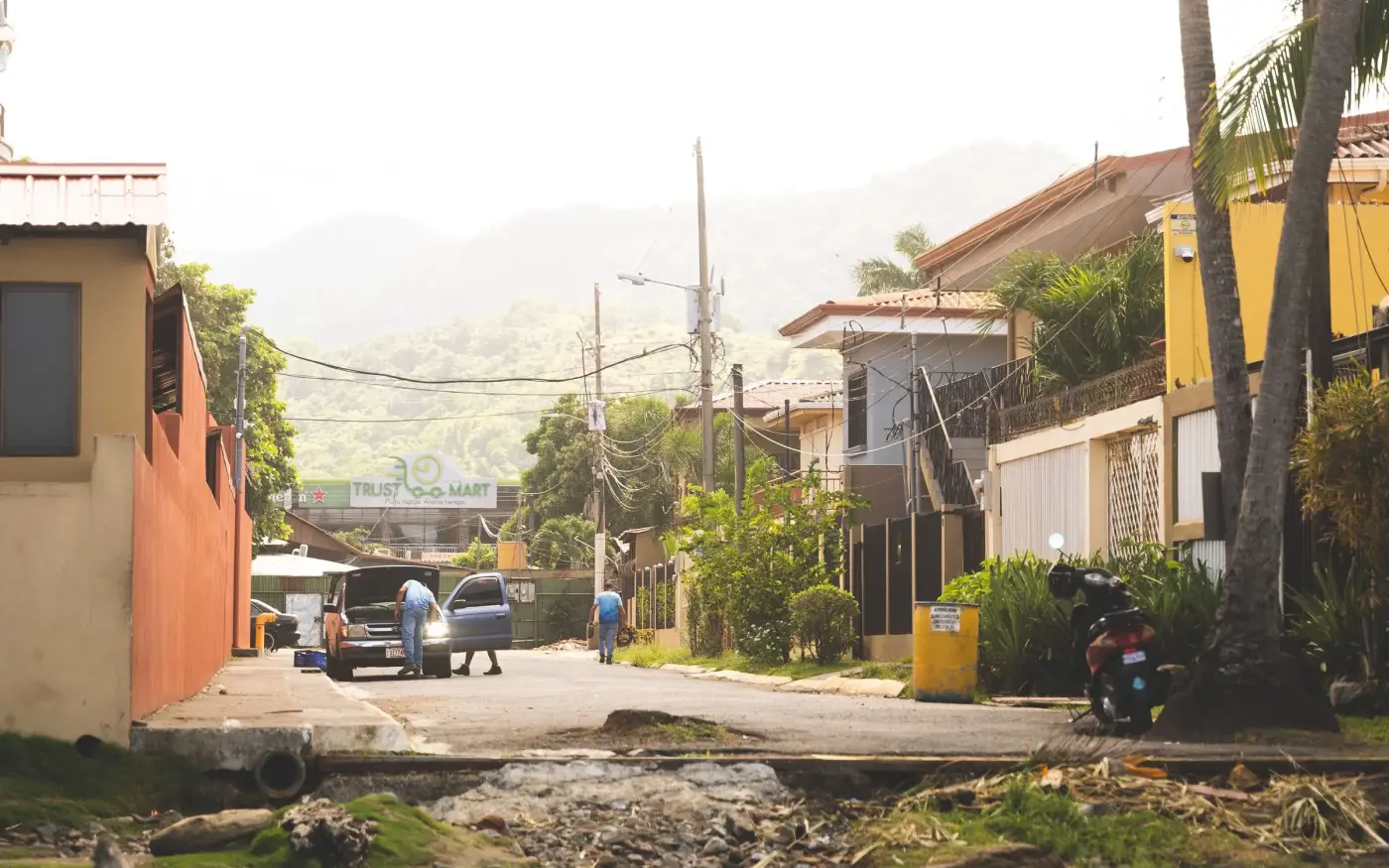
The honest picture is that the pavement stops mattering once you leave the spine. The same inventory records the roads north-west of Cóbano as gravel with frequent potholes and drainage it describes as inadequate. In January 2026 a Cóbano councillor told the chamber that foreign visitors were getting bogged on the Río Arío road toward Manzanillo and spending the whole day stuck. In April 2026 another described the Santa Teresa to Playa Hermosa stretch past the old Lora Amarilla as simply *intransitable*.
So: a normal car is fine for the ferry road, for Cóbano, for Montezuma and for Cabo Blanco. Clearance and, in the wet season, four driven wheels start to matter the moment you head north past Playa Hermosa toward Manzanillo, or inland on the gravel. Decide based on where you are actually going, which is not the question the rental counter will ask you.
One more correction worth having: "Santa Teresa’s roads are unpaved" is out of date. The district paved the Playa Carmen junction in 2025 for close to ₡100 million, laid asphalt from Puente Merucho to the Playa Hermosa entrance the same year, and finished a cobbled beach access in May 2026 — while other stretches were still being called impassable. The truthful description is mixed, and changing year to year.
Cabo Blanco: the trip that justifies the drive
About forty minutes south, past Cabuya, the road ends at the gate of the Reserva Natural Absoluta Cabo Blanco. It was established on 21 October 1963, and it is the reason Costa Rica has a national park system at all: Nicolas Wessberg and Karen Mogensen, a Swedish-Danish couple farming nearby, watched the forest being cleared and bought what was left. Wessberg was murdered in 1975 while buying land for what became Corcovado. His killers were never identified. Mogensen died in 1994.
You will see Cabo Blanco called Costa Rica’s first protected area. SINAC’s own management plan says so on one page and contradicts it twenty pages later, noting a 1945 designation and a 1955 law that had already declared volcano craters national parks. The fair version is that Cabo Blanco was the first land protected by deliberate private purchase for conservation’s own sake — which is a better story than the one it gets replaced with.
The practical details matter more than the history here, because getting them wrong costs you eighty minutes of driving:
It is closed Mondays and Tuesdays. Open Wednesday to Sunday, 8am to 4pm.
There is no way to book. Cabo Blanco is not in SINAC’s online reservation system — we checked the list, and it is not there. Tickets are sold at the gate.
Bring colones. SINAC publishes a list of parks where payment is by card only, and Cabo Blanco is not on it either. The reserve has no web presence of any kind, so assume nothing about the card reader.
The fee is probably $12 for non-residents and ₡1,600 for residents — but that figure traces back to a 2018 tariff table SINAC has never replaced, so treat it as approximate and carry more than you expect to need.
The beach hike wants four to five hours round trip against a 4pm closing. Arrive by late morning or do the shorter loop instead.
Almost every guide states that Cabo Blanco admits only forty visitors a day and that reservations are required. The tourism board says it. But SINAC’s own statistics record 11,799 visits in 2025, and a Wednesday-to-Sunday year has 261 open days — a hard cap of forty allows 10,440. The average works out at 45 a day, and a real cap could not produce an average sitting at the cap, because quiet days would drag it down. Two government sources disagree, and there is no booking channel to use even if you wanted one. Turn up early on an open day and you will get in.
We are also not going to publish trail distances. The Sendero Sueco is given as 4.2 km, 4.5 km, 3 km and 10 km by different sources, and no official trail document exists, because SINAC has never published a management plan for the reserve. What is consistent is that the main trail reaches the beach and that people underestimate it.
The reserve next door is closed, and should stay that way
The Reserva Natural Absoluta Nicolás Wessberg, created in 1994, is sometimes listed as a nearby attraction. It is closed to tourism by the terms of Karen Mogensen’s will, which explicitly prohibits public entry and tourism of any kind. It records no visitation in any SINAC report. Please do not go looking for it.
Montezuma and its waterfall: read this part before you go
Montezuma is about forty minutes away over the hill through Cóbano, and it is the most enjoyable short trip on this list — a small town wedged between forest and a rocky shoreline, with better food than its size suggests. The waterfall above it is the single most photographed thing on this peninsula. It is also the part of this guide we would most like you to read carefully.
In August 2026 SINAC ordered a total halt to construction work at the waterfall. An inspection on 20 July found land-use change across roughly a hectare, illegal logging, earthworks and damage to the watercourse; the regional director suspended the works and the case went to the OIJ. The neighbours who filed the complaint also reported that rocks had come down onto the bank beside the trail, below newly built gabions, and were still sitting there partially blocking it. They say the Municipality did not respond to their second warning.
We could not establish the current physical state of that slope, and nobody publishes one. But an unstable bank below recent earthworks that a government agency has just ordered stopped is worth knowing about before you set off, and no travel guide we found mentions it.
On the drownings: one death here is firmly documented, on 1 April 2015, when a young man entered the water and did not resurface; the Red Cross recovered his body that afternoon. Two outlets covering it disagree on his age and on whether he jumped. You will read that several people have died at these falls. That plural traces back to a single 2015 article quoting one guide’s recollection — no dates, no names, no agency confirmation. We are not going to print a death toll, because no authority publishes one, and inventing a number to sound cautious is its own kind of dishonesty.
What we can say plainly: there is no official safety statistic, no prohibition, no lifeguard and no signage of any authority here. There is one confirmed death, credible but unverifiable reports of others, a cliff people jump from, and a slope that is currently the subject of an environmental enforcement action. Treat the upper pools as unsupervised wild water, because that is exactly what they are.
There is no official parking or entrance tariff either. Payment is an informal cash collection by a local; reported amounts run from about ₡1,000 to ₡2,000. Four sets of Cóbano council minutes across seventeen years contain not one mention of the waterfall, so nobody appears to be collecting it under any authority we could identify. Bring small notes and treat it as the cost of parking.
Isla Tortuga: the full day that actually works
Isla Tortuga is sold from half the country, which makes it sound like a marketing exercise from here. It is not. The Santa Teresa itinerary picks up on Calle Cóbano between 7:45 and 8:20, transfers about thirty-five minutes to Montezuma, boards at 9:30, and has you back around 4:30. That is eight to nine hours door to door for roughly $90 to $108, and it is a genuine day trip rather than a brochure one.
Two things worth knowing. The first is that boats do not leave from Santa Teresa, and the ones marketed "from Paquera" are a different product with a different pickup — from here the route runs through Montezuma, and an operator quoting you a Paquera departure is quoting a trip that starts over an hour away. The second is that "from Jacó" listings are a hotel pickup followed by a departure from Herradura, not a sailing from Jacó, which is worth knowing if you are comparing prices across the gulf.
One myth to retire: the island is not inside the Islas Negritos Biological Reserve. We searched SINAC’s official registry of protected areas in two editions — Tortuga, Tolinga and Alcatraz return nothing, while the control terms all appear. Isla Tortuga sits inside no Costa Rican protected area at all. The only charge that reaches visitors on the island is a dollar for the toilets.
Curú: the one that repays a slow morning
Curú is about an hour and a quarter up the road toward Paquera, and it is an unusual thing: a private hacienda whose owners had it declared a national wildlife refuge in 1983. It is small — the protected area is 90.48 hectares, not the 1,496 you will see quoted, which is the family’s whole estate — and it is dense with animals precisely because it is small and old and undisturbed.
It opens at 7am daily and closes at 4pm to day visitors. Admission is $18 for adults and $10 for children. And here is the trap: Curú takes cards only and explicitly refuses cash — the exact inverse of Cabo Blanco, forty minutes the other way, where you should assume you need colones. If you are doing both in one trip, carry both.
Check the refuge’s own trail notices before you commit to a route. At the time of writing, the Killer and Avispero trails were closed, the link from the Mirador to Poza Colorada was closed by landslides, and Playa Quesera needed booking ahead by WhatsApp. None of the tour listings we looked at mentioned any of this.
Curú is also the smartest way to combine two trips: the Isla Tortuga boats leave from the refuge’s own beach, about 3 km from the islands, and a combined refuge-and-island package runs about $77 for six hours. Note that the refuge’s official site never mentions boats or snorkelling at all — that product is sold through a separate company run by the founding family, which is why searching for it is confusing.
Jacó by boat: the trip that makes no sense by road
Jacó is about 248 km away around the Gulf of Nicoya and nobody sensible drives it for a day. By sea it is straightforward: the taxi boat leaves Montezuma at 8:30am, reaches Herradura at 9:30, and a shuttle has you in Jacó by 10, from about $55. The same boat runs on to Manuel Antonio by 11am for $80 — though with the return boat governing your day, Manuel Antonio is an overnight rather than a day trip.
This is the one case where a glance at a map is actively misleading in your favour. The water crossing is short; the land route is a full day in each direction.
What does not work from Santa Teresa
This is where the peninsula gets people. Sámara looks close. Nosara looks close. On a map, the coast road north runs straight up to them. In practice the shuttle operators — who drive it for a living — publish 4½ to 5 hours to Sámara and 5 to 6 hours to Nosara. That is nine to twelve hours in a van for a beach, and you are already on one.
Sámara — 4½–5 hours each way, by the operator’s own figure.
Nosara — 5–6 hours each way.
Tamarindo — 5–6 hours each way.
Monteverde — about 5 hours. Stay overnight instead; it is worth two days.
La Fortuna and Arenal — about 5 hours. Same answer.
Liberia and LIR airport — 5–6 hours. Build in a night before an early flight.
Manuel Antonio — reachable by the morning boat, but the return sailing dictates your day. Overnight it.
The reason the map lies is the coastal road north through Manzanillo toward Arío. It exists, and routing engines love it, and it is gravel with unbridged river crossings. Travel sites will tell you the Río Bongo is passable only from January to April. That may well be true, but we could not confirm it: we searched thirty-three sets of Cóbano council minutes for the word *vado* and found exactly one use, generic and naming no river. The municipality’s documented river problems are all on the Cóbano and Montezuma side. So treat the northern shortcut as unverified rather than proven — and note that the five-hour operator times are themselves the clearest evidence that the short line on the map is not a usable road.
Getting here, and the ferry
Most people arrive via the Puntarenas to Paquera ferry, and the details published online are mostly stale. As of April 2026 there are eight sailings each way, at the same times in both directions: 4:00am, 6:30, 9:00, noon, 3:00pm, 6:00, 8:00 and 10:00. The widely copied six-sailing timetable — including the one on the national tourism board’s own site — is out of date.
Fares are ₡810 for an adult and ₡480 for a child, and free if you are 65 or over, which applies to any nationality on production of a passport. A car is ₡11,400 plus tax. The detail that catches people out: the vehicle fare does not include the driver, who has to be added as an adult passenger.
There is no real reservation system. Online sale covers a limited quota of spaces and the rest go at the terminal window, first come. Online purchases cannot be changed or refunded, and you are asked to be there thirty minutes ahead. We are not going to tell you how long the crossing takes, because the operator does not say and the figures in circulation range from sixty to eighty minutes.
One thing to plan around in the wet season: on 8 June 2026 Ruta 160 — the only sealed road between Cóbano and the ferry — was closed after a storm brought trees down on power lines. If you have a flight, give yourself a day of slack between June and November.
The two things to put in your bag
Colones in cash for Cabo Blanco and the waterfall parking, and a card for Curú. The two best trips from Santa Teresa have opposite payment rules, and both are forty minutes from anywhere that could fix the problem.
Questions people ask
Do I need a 4x4 in Santa Teresa?
Not for the main roads. The ferry road to Cóbano is fully paved, and Montezuma and Cabo Blanco are reachable in an ordinary car. No official Costa Rican source — MOPT, CONAVI, the road laboratory, the tourism board or the district council — recommends a 4x4 anywhere here; the advice comes overwhelmingly from travel sites and rental companies. Clearance genuinely starts to matter if you are heading north past Playa Hermosa toward Manzanillo, or inland on gravel, especially between May and November.
Is Cabo Blanco open on Mondays?
No. It is closed Mondays and Tuesdays, and open Wednesday to Sunday from 8am to 4pm. There is no way to check in advance beyond this, because the reserve has no website and is not in SINAC’s online booking system.
Do I need to reserve Cabo Blanco in advance?
You cannot. It is not in SINAC’s online reservation system. The tourism board states that reservations are required and that only 40 people a day are admitted, but SINAC’s own visitation figures average 45 a day and no booking channel exists, so the two government sources contradict each other. Arrive in the morning on an open day.
Can I pay by card at the parks?
It depends which one, and they are opposites. Curú takes cards only and explicitly does not accept cash. Cabo Blanco is absent from SINAC’s list of card-payment parks, so carry colones. The Montezuma waterfall parking is an informal cash collection.
Can I do Sámara or Nosara as a day trip?
No. The shuttle operators publish 4½–5 hours to Sámara and 5–6 hours to Nosara one way. The coast road that looks short on a map is gravel with river crossings, which is why the professionals quote five hours for what appears to be 78 km.
Is the Montezuma waterfall safe?
It is unsupervised wild water with no signage, no lifeguard and no published safety record. One death is firmly documented, in April 2015. Reports of others exist but trace to a single article quoting one guide, so we will not print a figure. Separately, SINAC ordered construction at the site halted in August 2026 after finding illegal logging and earthworks, and neighbours reported fallen rocks partially obstructing the bank beside the trail. Go carefully and do not jump.
Is Isla Tortuga really a day trip from Santa Teresa?
Yes, genuinely. Pickup is on Calle Cóbano between 7:45 and 8:20am, the boat leaves Montezuma at 9:30, and you are back around 4:30 — eight to nine hours for roughly $90–108. Ignore listings that depart from Paquera; those start over an hour away.
How long does the ferry take?
Nobody official says. The operator publishes the distance, 18.2 km, but no journey time, and travel sources give everything from 60 to 80 minutes. Plan around the sailing times rather than the crossing length, and remember the vehicle fare does not cover the driver.
Santa Teresa rewards staying put more than most places do, and the trips worth taking from it are nearly all inside forty minutes. If you take one, make it Cabo Blanco on a Wednesday morning with cash in your pocket — for the forest, and for the two people who bought it before anyone else thought to.
Sources
Facts in this guide were checked against these references on the dates shown.
SINAC — Reservaciones en línea — SINAC lists the thirteen protected areas whose tickets are sold through its online system (Chirripó, Poás, Tortuguero, Isla San Lucas, Irazú, Manuel Antonio, Barva, Tapantí, Tenorio, Carara, Rincón de la Vieja and Los Quetzales); telephone booking covers only Barra Honda and Turrialba, and email only the ACOSA parks. Cabo Blanco appears in none of these lists. The page states that entry to other national parks is made by telephone reservation, email, online reservation and at the park ticket office ("boletería del parque"). (accessed 23 September 2026)
SINAC — Áreas Silvestres Protegidas de Costa Rica 2020 (official registry) — Reserva Natural Absoluta Cabo Blanco (code N01, state-owned, ACT) is recorded as 1,369.57 ha terrestrial, 1,667.62 ha marine and 16.98 ha island. Refugio Nacional de Vida Silvestre Curú (code V05, mixed ownership, ACT) is recorded as 90.48 ha, created by Decreto 14378-A of 1983. The terms "Tortuga", "Tolinga" and "Alcatraz" return zero occurrences in the registry in both the 2020 and 2025 editions, while the control terms Curú, Negritos and San Lucas are present — so Isla Tortuga lies inside no Costa Rican protected area. (accessed 23 September 2026)
SINAC — Plan General de Manejo, Reserva Natural Absoluta Nicolás Wessberg (2013).pdf) — Cabo Blanco was established on 21 October 1963 by Decreto Ejecutivo Nº 10 (p.24). The same document calls it "la primera área protegida en Costa Rica" on p.14 but records on p.24 that the first dates to 1945 (Parque Nacional Los Robledales) and that the 1955 ICT law No. 1917 had already declared volcano-crater zones national parks. Nicolas Wessberg was murdered in 1975 while buying land for what became Corcovado, and his killers were never identified; Karen Mogensen died in October 1994 (pp.14–15). The neighbouring Reserva Natural Absoluta Nicolás Wessberg was created by Decreto Ejecutivo 23701-MIRENEM of 10 October 1994 and is closed to tourism by the terms of Mogensen’s will, which prohibits "La entrada de particulares" and "Turismo de cualquier oficio turístico" (p.26). (accessed 23 September 2026)
SINAC — Informe anual Estadísticas SEMEC 2025, "SINAC en Números" — Cabo Blanco recorded 11,799 visits in 2025 (2,343 residents and 9,456 non-residents, 0.40% of the national total), against 10,194 in 2024 and 11,107 in 2023 (Cuadro 6, p.21). On a Wednesday-to-Sunday opening pattern of 261 open days, 11,799 visits average 45.2 per open day — above the 40-per-day cap widely reported elsewhere, and arithmetically impossible under a strictly enforced cap, since quieter days would have to pull the average well below it. (accessed 23 September 2026)
ICT (Instituto Costarricense de Turismo) — Admission fees and hours of operation, Costa Rica’s national parks — Cabo Blanco is open Wednesday to Sunday, 8am–4pm, and closed Mondays and Tuesdays; admission is given as ₡1,600 for residents and $12 for non-residents. The fee pair matches the figure in SINAC’s 2018 tariff table, which SINAC still publishes as its only fee document, so the amount should be treated as unconfirmed and whether 13% IVA is added on top could not be established. (accessed 23 September 2026)
ICT — Inside Cabo Blanco Absolute Natural Reserve — The national tourism board states that only 40 tourists are allowed to enter per day and that reservations are required. This conflicts with SINAC’s own visitation statistics and with the absence of any reservation channel for Cabo Blanco in SINAC’s booking system — two government sources in direct disagreement. (accessed 23 September 2026)
Refugio Nacional de Vida Silvestre Curú — day admission booking and terms — Current day admission is $18 per adult and $10 per child for foreign visitors, with national rates equivalent to $7 and $4. The refuge’s own FAQ states that payment is by Visa or Mastercard at the entrance and that cash is not accepted. Opening hours are 7am–4pm daily for day visitors, with only cabin guests permitted to remain later. The refuge’s live trail notices list Sendero Killer and Sendero Avispero as closed, the Mirador to Poza Colorada link closed by landslides, and Playa Quesera as requiring advance booking by WhatsApp. (accessed 23 September 2026)
Curú Tourism — tours and Isla Tortuga departures — Boats to Isla Tortuga depart at 9am from Curú beach inside the wildlife refuge, roughly 3 km from the islands; a combined refuge-and-island package is sold at $77 per adult for about six hours. Horseback tours are $24–$36 and the listings state explicitly that the price does not include the refuge entrance fee. (accessed 23 September 2026)
Isla Tortuga Tour — Tortuga Island day trip from Santa Teresa — The Santa Teresa itinerary collects passengers between 7:45am and 8:20am on Calle Cóbano, transfers about 35 minutes to Montezuma, boards the boat at 9:30am and returns to Santa Teresa around 4:30pm — roughly eight to nine hours door to door, at about $90–108. The trip is routed via Montezuma, not via Paquera. The operator’s separate Jacó listing shows that "from Jacó" is a hotel pickup at 6:50am followed by a 7:45am departure from Herradura, not a sailing from Jacó. (accessed 23 September 2026)
Semanario Universidad (UCR) — "Autoridades ordenan paralizar construcción en catarata Montezuma tras denuncia de vecinos que destapó tala e invasión" — Published 13 August 2026. A SINAC inspection of 20 July 2026, recorded in oficio CARTA-SINAC-ACT-OSRC-284-2026, found land-use change over roughly one hectare, illegal logging, earthworks and damage to the water resource at the Montezuma waterfall; ACT regional director Nelson Marín ordered a total suspension of the works and the case was referred to the OIJ. The filed citizen complaint also reports that rocks have fallen onto the bank of the Río Montezuma beside the trail, below newly built gabions, and remain there partially obstructing it, and that the Municipality did not respond to a second warning. (accessed 23 September 2026)
La Nación — "Joven de 28 años fallece ahogado en Cóbano" — Published 1 April 2015 (the article’s own structured data gives datePublished 2015-04-01T22:40:58Z, though search engines commonly misdate this story to October 2017). A 28-year-old man from Grecia entered the water at the Montezuma waterfall and did not resurface; the Cruz Roja de Cóbano located his body at 12:30pm about 20 m away and the OIJ recovered it at 2pm. Teletica covered the same death and gives the age as 22 and says witnesses saw him jump; the discrepancy is not resolvable from either report. (accessed 23 September 2026)
Tropical Tours Shuttles — published route times from Santa Teresa — Operator-published journey times one way from Santa Teresa: Tambor airport 1 hour; Sámara 4½–5 hours ("depending on the road conditions"), shared $60 and private $260; Nosara 5–6 hours; San José airport about 5 hours; Liberia (Daniel Oduber Quirós) 5–6 hours. The Montezuma to Jacó taxi boat departs Montezuma at 8:30am and reaches Herradura at 9:30am, with a shuttle on to Jacó by 10am, from $55; the same boat continues to Manuel Antonio by 11am for $80. (accessed 23 September 2026)
MOPT / CONAVI — Red Vial Nacional, February 2026 inventory (ArcGIS FeatureServer) — Ruta 160 from the Paquera ferry junction to Cóbano is fully asphalted across sections 60811, 60812 and 60813, totalling 33.66 km, with the Tambor–Cóbano section rated "Superficie generalmente lisa, pero con unas pequeñas corrugaciones u otras irregularidades aisladas, o con baches pequeños superficiales" and posted speeds of 40, 50 and 35 km/h. North-west of Cóbano the same route is gravel ("Lastre o grava") in "Superficie con frecuentes baches o irregularidades" condition with drainage recorded as inadequate. A geographic query over a box enclosing Santa Teresa, Playa Carmen, Playa Hermosa and Mal País returns no national-route section serving Santa Teresa or Mal País: nationwide text queries for "MAL PA" and "MALPA" return zero rows, and "TERESA" returns four rows, all in Pérez Zeledón and Pococí. Those roads are cantonal, not national. No MOPT, CONAVI, LANAMME, ICT or municipal source consulted recommends a 4x4 anywhere in the area. (accessed 23 September 2026)
Concejo Municipal de Distrito de Cóbano — ACTA N°096-2026 (3 March 2026), annual accountability report — Works delivered in 2025 include asphalt at the Playa Carmen junction in Santa Teresa at a cost of nearly ₡100 million funded by the local government and the MOPT-BID programme, asphalt from Puente Merucho to the Playa Hermosa entrance, and about 450 m between Delicias and Montezuma. Other 2025 projects were blocked in the Municipalidad de Puntarenas budget ("improbado en presupuesto Puntarenas"), including the Santa Teresa–Hermosa stretch past the old Lora Amarilla. The minutes also state that no survey of Cóbano’s cantonal roads has been carried out ("No se ha realizado el levantamiento de las rutas cantonales correspondientes a Cóbano"). A word-boundary search of 33 sets of council minutes covering January 2025 to July 2026 found exactly one genuine use of "vado", in generic policy language naming no river. (accessed 23 September 2026)
Concejo Municipal de Distrito de Cóbano — ACTA N°103-2026 (21 April 2026) and ACTA N°090-2026 (20 January 2026) — In April 2026 a councillor described the cantonal road between La Lora Amarilla and Puente Merucho, on the Santa Teresa to Playa Hermosa stretch, as "intransitable". In January 2026 another councillor reported bogging points on the Río Arío to Manzanillo road where foreign visitors get stuck: "Hay unos pegaderos ahí… Hoy todo el día esa gente pegado." (accessed 23 September 2026)
La Nación — "Cerrada ruta 160 que comunica Cóbano y Paquera" — Published 8 June 2026. Ruta 160, the paved link between Cóbano and Paquera, was closed after heavy rain brought trees down onto power lines; MOPT said the electricity operator had to clear the line before CONAVI could work, and drivers were told to take alternative routes. The CNE had an alert in force for Pacific cantons. This was a fallen-tree closure rather than a river crossing being washed out. (accessed 23 September 2026)
ARESEP — Tarifas del ferry (cabotaje mayor) — Regulated passenger fares on the Puntarenas–Paquera ferry operated by Naviera Tambor S.A. are ₡810 for adults and ₡480 for children, set by resolution RE-0074-2026 and in force from 1 July 2026; passengers aged 65 and over travel free. ARESEP separately confirms that the senior exemption applies to those 65 and over of any nationality on production of a passport or DIMEX, so foreign visitors qualify. Vehicle fares and the concession are handled by MOPT’s División Marítima Portuaria rather than ARESEP, and INCOP does not regulate or publish ferry fares at all. (accessed 23 September 2026)
Naviera Tambor — Horarios y Tarifas, and QuickPayCR (authorised ticketing) — Eight sailings run each way daily at identical times in both directions — 4:00am, 6:30am, 9:00am, 12:00 noon, 3:00pm, 6:00pm, 8:00pm and 10:00pm — in force from 20 April 2026 until further notice, with no weekday, weekend or holiday variation published. A light vehicle is ₡11,400 plus IVA and a motorcycle ₡3,400 plus IVA. The authorised online seller states that the vehicle fare does not include the driver, who must be added as an adult passenger, that online sale covers only a limited quota of spaces authorised by the regulator with the remainder sold at the terminal windows, that purchases are final with no changes or refunds, and that passengers should arrive 30 minutes before departure. No official or operator source states a crossing time; travel sources give figures between 60 and 80 minutes that contradict one another. (accessed 23 September 2026)
OpenStreetMap routing via the OSRM public routing engine — Free-flow driving estimates one way from Santa Teresa used as the basis for the local drive-time table: Playa Carmen 0.9 km/3 min; Mal País 6.7 km/17 min; Cóbano 9.7 km/27 min; Montezuma 15.1 km/40 min; Cabuya 15.2 km/38 min; Cabo Blanco entrance 15.4 km/38 min; Tambor 26.5 km/54 min; Paquera 43.3 km/75 min. Cabuya to the Cabo Blanco entrance is 2.1 km/5 min and Montezuma to Cóbano 7.9 km/14 min. For longer routes the engine is unreliable here because it routes via the unpaved coastal road and returns times far shorter than operators publish, so operator figures are used for everything beyond Paquera. (accessed 23 September 2026)
Plan this trip
Browse the tours that fit what you’ve just read — real operators, real prices, book direct.
Browse tours from Santa Teresa