Wildlife & Nature
Guanacaste Wildlife: What You Can Actually See
Guanacaste Experiences editorial team
·
23 September 2026
·
19 min read
Hero photo: Gouldingken / Wikimedia Commons (CC BY-SA 3.0)
In this guide
The one sentence that explains the restThe three animals that probably aren’t where you thinkToucans: real, but up the mountainThe red-eyed tree frog: not a Guanacaste animalSloths: the honest answerWhat you can actually expect to seeDry season helps — but not for the reason you’ve readWhat “sanctuary” means in Costa Rican lawThe register that would let you check doesn’t existHow to choose a wildlife experience hereTurtles are their own subjectThe honest summaryLook at the wildlife photography selling almost any Guanacaste holiday and you will see the same three animals: a keel-billed toucan, a red-eyed tree frog, and a sloth hanging from a branch. All three are real Costa Rican animals. Two of them are, in the part of Guanacaste where you are probably staying, essentially fiction.
This is not a scandal and nobody is lying to you on purpose. Those three animals are the national brand — they appear on tourism posters for the whole country, and Costa Rica genuinely has them. It is just that the country is a mosaic of very different forests, and the beach side of Guanacaste is the one where those particular animals mostly are not.
The good news is that what you *can* see here is excellent, and knowing what to expect is the difference between a great wildlife day and a vaguely disappointed one.
Where this comes from
Everything below is from published research, Costa Rican law, or the conservation bodies that work these forests — not from tour marketing, including our own. Where the evidence is a pattern in citizen-science reporting rather than a formal published finding, we say so explicitly. Nothing here is a promise: wild animals are wild, and the honest answer to “will I see one?” is always “maybe”.
The one sentence that explains the rest
You will read that “Guanacaste is dry forest, not rainforest.” That is half right, and the half that is wrong is exactly the half that matters for wildlife.
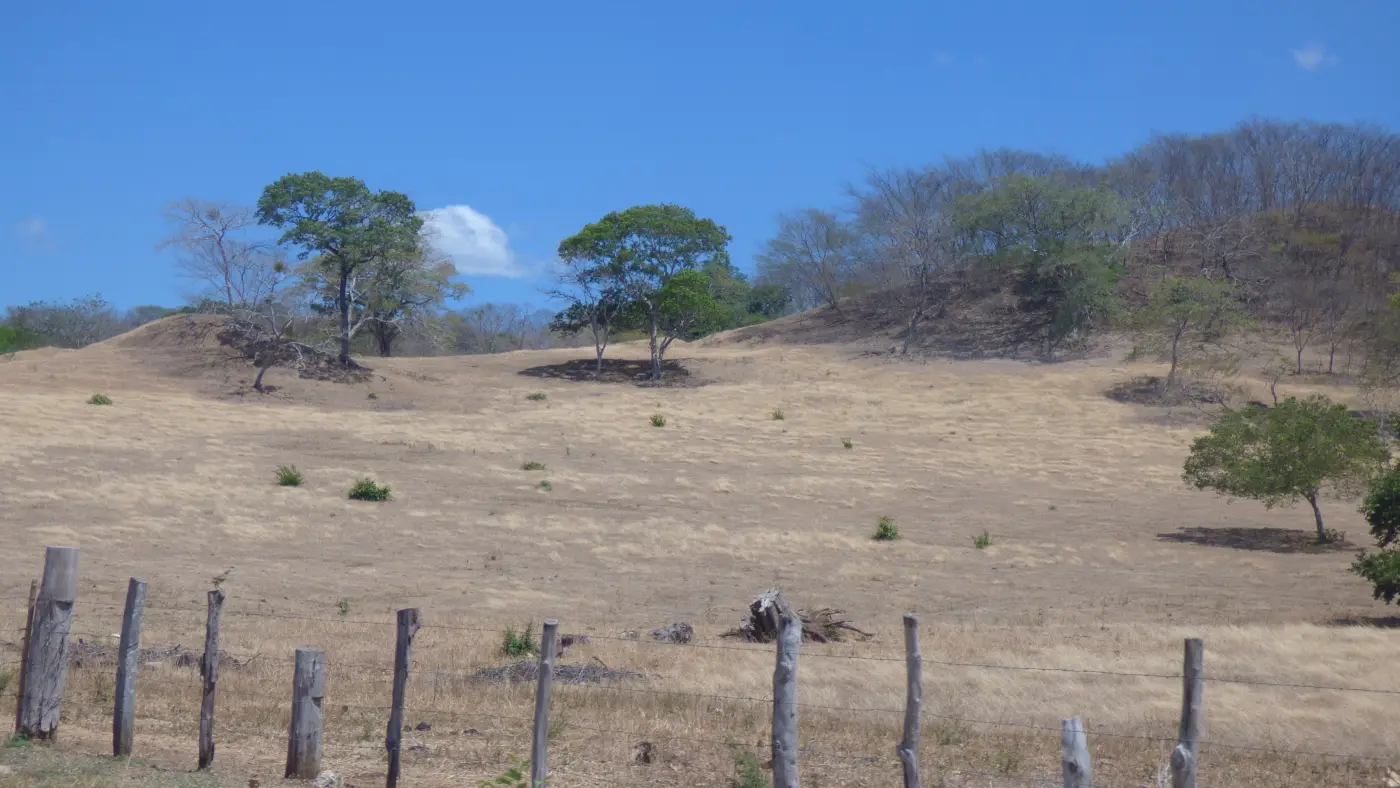
The Pacific lowlands of Guanacaste — the beaches, the resorts, Tamarindo, Flamingo, Coco, Papagayo — are tropical dry forest. That is a genuinely rare and important ecosystem, and the numbers are bleak. When the Spanish arrived there were roughly 550,000 square kilometres of dry forest down the Pacific coast of Mesoamerica, an area about the size of France. Daniel Janzen’s assessment is that less than 2% of it is now sufficiently intact to interest a conservationist, and that under a tenth of one per cent has any official protected status at all.
But the province is not one thing. It climbs to nearly 1,900 metres at the summit of Rincón de la Vieja, and the Área de Conservación Guanacaste — the protected area covering much of the north — runs a management sector it calls, in its own words, Sector Rincon Rain Forest. There is real rainforest in Guanacaste. It is simply up the mountain rather than by the sea.
So the useful mental model is not “Guanacaste = dry forest”. It is altitude and rainfall: dry deciduous forest at the coast, wet forest on the upper slopes of the volcanoes an hour or two inland. Almost every “where are the animals?” question here answers itself once you know which of those two you are standing in.
One more thing before you set expectations: dry forest carries fewer species than the rainforest over the mountains. How many fewer is genuinely disputed, and we are not going to pretend otherwise — the Guanacaste Dry Forest Conservation Fund states that for any given taxonomic group the species count is 50–80% lower, while Janzen’s own published estimate puts dry forest at 50–100% *as* species-rich as the neighbouring rainforest. Those are different claims from broadly the same lineage of researchers. The direction is the same either way, and it means a Guanacaste beach holiday is not a Corcovado biodiversity trip — no guide can make it one.
The three animals that probably aren’t where you think
Toucans: real, but up the mountain
The keel-billed toucan is genuinely present in Guanacaste — on the wet upper slopes of Rincón de la Vieja, which is a mainstream day trip from every beach town on this coast. What it is not is a beach bird or a dry-forest bird.
The pattern in public biodiversity records is stark. Counting how often birders report each species, per 10,000 bird records from each area:
Reporting rates from public biodiversity records, per 10,000 bird records. These describe how often birdwatchers report a species, not how many birds are there — but the comparison between sites is meaningful, and the motmot column is the control.
Area
Keel-billed toucan
Turquoise-browed motmot
Rincón de la Vieja (wet slope)
174
126
Santa Rosa (dry forest)
18
80
Tamarindo / Playa Grande
3
127
Papagayo / Playas del Coco
2
131
The second column is why the first one can be trusted. If toucans were simply under-reported at the beaches because nobody birds there, the motmot would be under-reported too — and it is not. Motmots are reported at roughly the same healthy rate everywhere. Plenty of people are watching birds at Tamarindo; they are just not seeing toucans, because toucans are not there.
Two related corrections while we are here. The fiery-billed aracari is a south-Pacific bird — Costa Rica’s public records put it overwhelmingly in Puntarenas, with a literal handful in Guanacaste. The emerald toucanet is a highland bird, a Monteverde species. Neither is a Guanacaste beach prospect.
So: a toucan photograph on a Guanacaste resort brochure is not fraudulent, but it is describing a day trip, not a balcony view. Book Rincón de la Vieja and your odds are real.
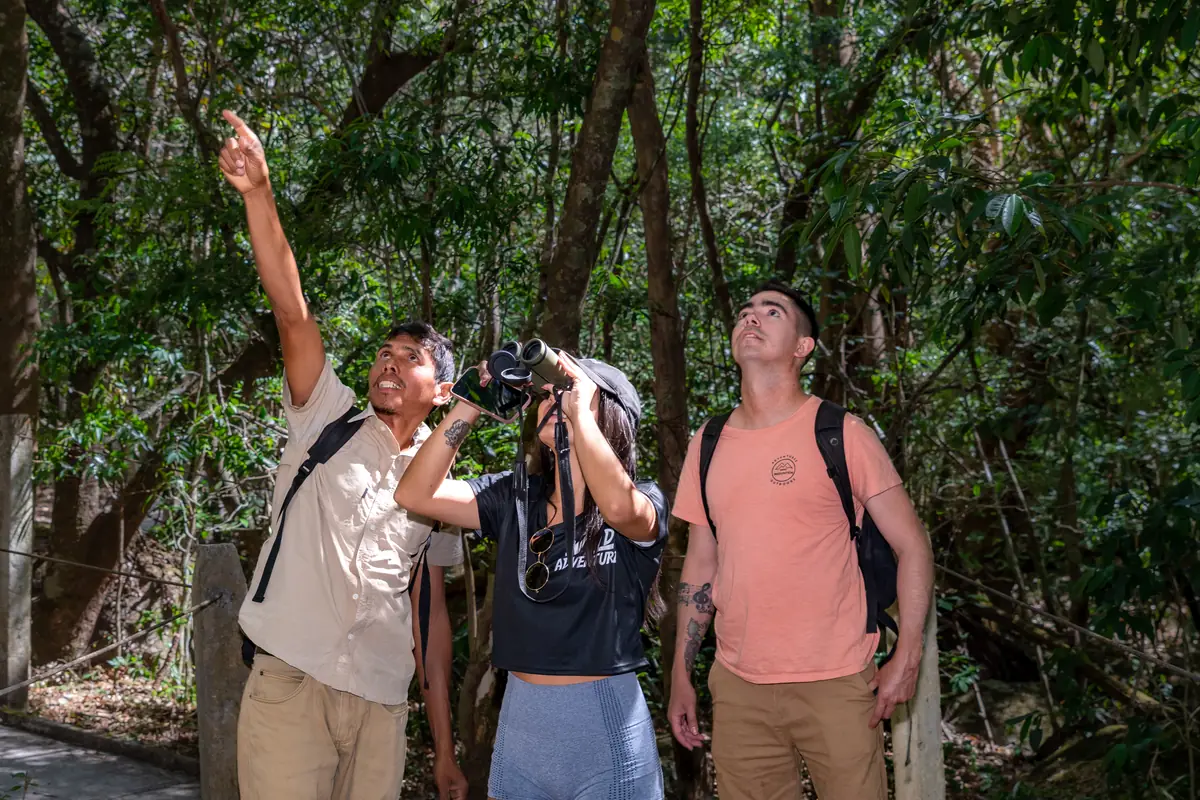
This is what you are actually buying on a guided walk: someone who knows where to look, and the binoculars to confirm it. Photo: @Ottiux / Hotel Hacienda Guachipelín (used with permission)
The red-eyed tree frog: not a Guanacaste animal
This is the clearest case of the three. A 2023 survey of amphibians across three adjacent ecosystems in the Área de Conservación Guanacaste recorded 660 individual amphibians from 37 species. In the dataset the authors published alongside it, the red-eyed tree frog appears zero times at either dry-forest site, and once in the entire study — at the rainforest site. The fieldwork ran from August to November, in the rains, which is when frogs are easiest to find.
And the survey can carry that weight, because the sampling at Santa Rosa was statistically complete — the estimator predicted six amphibian species and the fieldwork found six. That is a fully characterised community with no red-eyed tree frog in it, which is a much stronger statement than “we looked and didn’t find one”.
Guanacaste’s dry forest does have tree frogs. They are *Smilisca baudinii*, the Mexican tree frog, and *Trachycephalus typhonius*, the milk frog. Both are genuinely interesting animals and neither has red eyes on a green body with blue flanks, which is why they are not on the poster.
Sloths: the honest answer
The IUCN specialist group that writes the Red List assessment for sloths describes Hoffmann’s two-toed sloth as living in evergreen and semi-deciduous moist forest, and as “rare or absent in lowland dry forest.” That is the Red List Authority on the species, describing precisely the habitat that covers Guanacaste’s entire coast. And there is not a single voucher specimen of either sloth species from Guanacaste province in the global biodiversity record — every record there is a sighting, none a confirmed collected animal.
Sloths do turn up, sparsely, on the wet slopes of Rincón — the same wet forest as the toucans, and at a rate perhaps fifty times lower than the Caribbean and south Pacific places people actually go to see sloths.
Why we won’t quote you a “sloths near Tamarindo” statistic
There are sloth records from coastal Guanacaste — around Tamarindo, Conchal and Carrillo. They also sit almost exactly where wildlife facilities and adventure parks operate. Nobody has established whether those animals are wild or captive, so citing them as evidence of wild sloths on this coast would be dishonest. We are telling you the records exist and that they cannot be interpreted, which is the truthful state of the evidence.
What this means practically is simple, and it is not bad news: if you want to see a sloth from a Guanacaste beach base, you take a day trip inland. That is precisely what the sloth tours here are — full days that drive you to Tenorio, to Rincón’s wet side, or to a wildlife facility. They are the right answer to the question. They are just not a beach activity, and anyone who tells you to watch the trees outside your hotel is wasting your holiday.
What you can actually expect to see
Now the good part. Dry forest is superb for watching animals, and for one specific structural reason: it is open. You can see through it. A howler monkey forty metres up a rainforest canopy is a noise; a howler monkey in a dry-forest tree is a monkey.
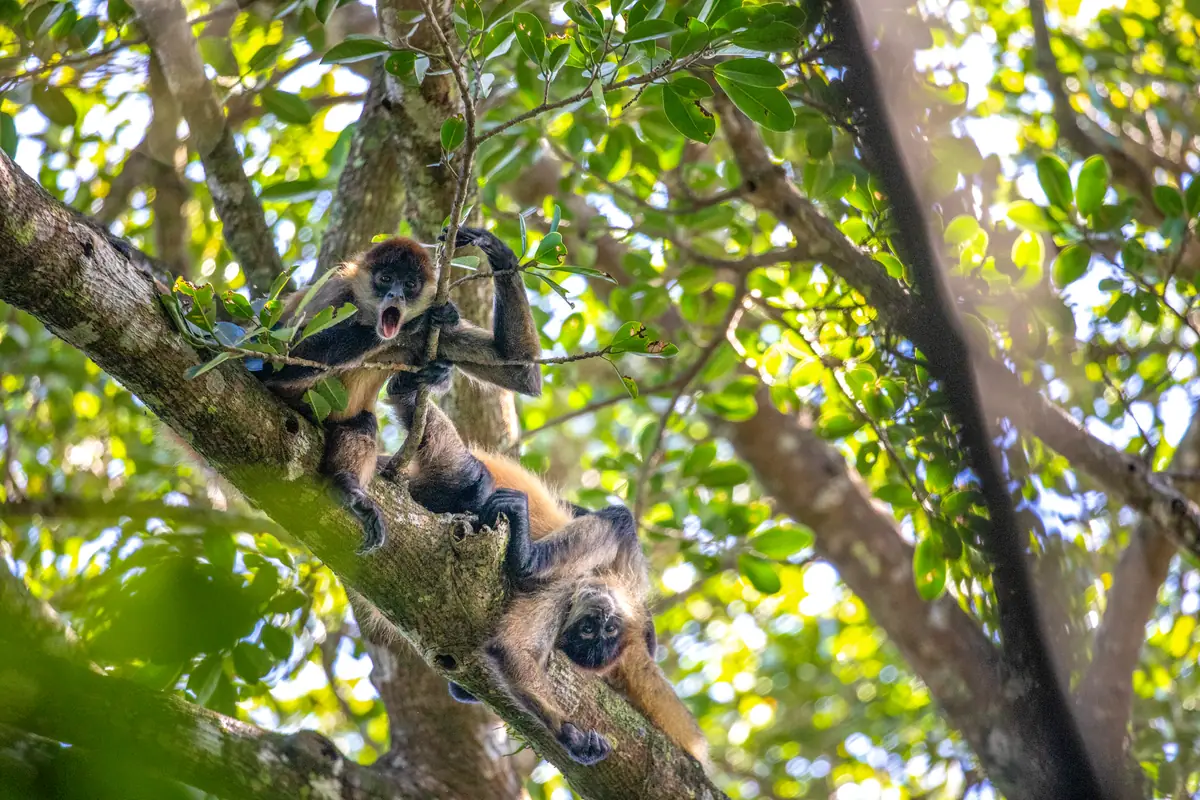
Geoffroy’s spider monkeys at Rincón de la Vieja. Researchers counted 122 of them at a single Guanacaste water hole across seven weeks of dry season. Photo: Arturo Bullard / Hotel Hacienda Guachipelín (used with permission)
The realistic list. “Water holes” refers to the dry-season concentration effect described in the next section.
Animal
Where and when
Realistic?
Turquoise-browed motmot
Everywhere, all year — beaches, gardens, dry forest. Reported at a steady rate across every area we checked.
Very likely
White-faced capuchin
Dry forest and park edges; counted at around fifteen a day at dry-season water holes.
Very likely
Howler monkey
Widespread in dry forest and around many beach towns. You will hear them before you see them.
Very likely
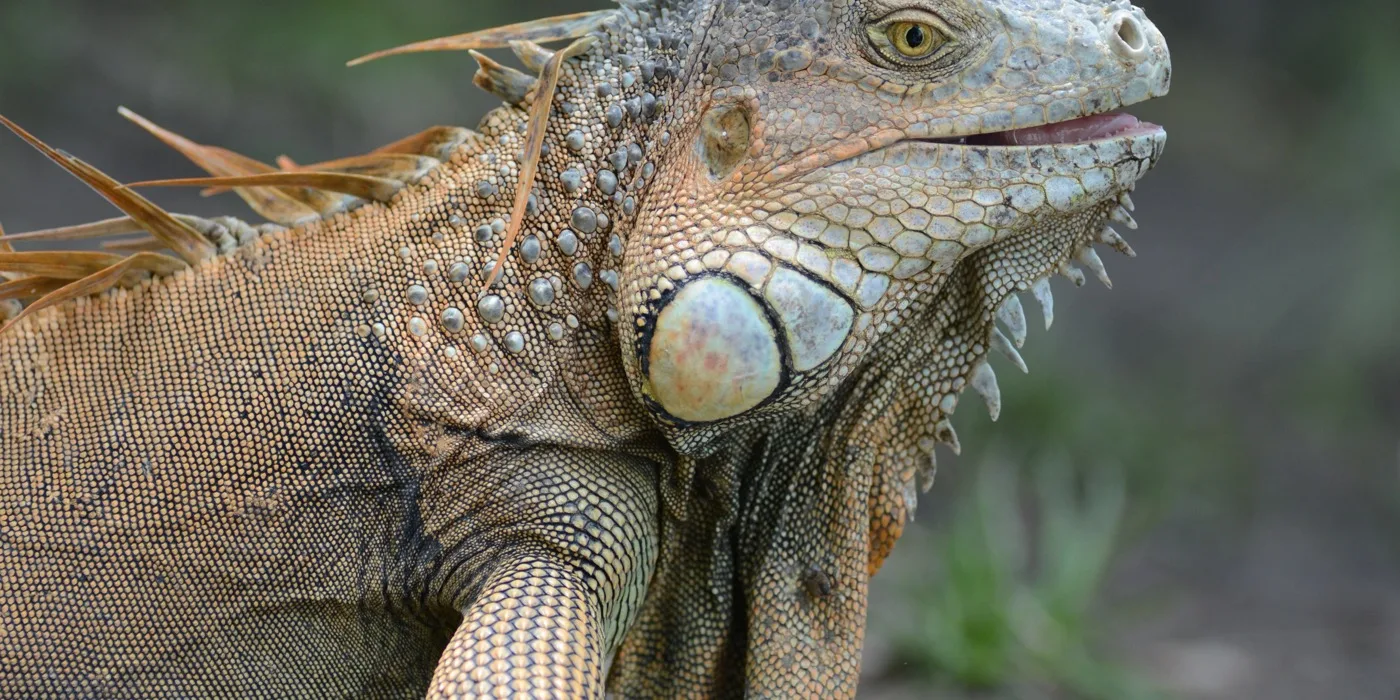
Green iguana & black spiny-tailed iguana
Dry forest, riverbanks, and frankly a lot of hotel grounds.
Very likely
Coati
Dry forest; among the most numerous animals counted at dry-season water holes.
Likely
Collared peccary
Dry forest; heavily represented in water-hole counts.
Likely
White-tailed deer
Dry forest and open country. Costa Rica’s national animal.
Likely
Great curassow
Dry forest floor; well represented at water holes.
Possible
Spider monkey
Dry forest, patchier than howlers and capuchins.
Possible
Keel-billed toucan
Wet upper slopes of Rincón de la Vieja only — a day trip, not the coast.
Possible, up the mountain
Crocodile
Estuaries, notably the Tamarindo estuary, which carries a warning sign.
Possible — keep your distance
Sloth
Wet forest inland, very sparsely. Reliable sightings are at facilities, not in the wild.
Unlikely in the wild
Red-eyed tree frog
Not a Guanacaste dry-forest animal.
No
If you want one bird to build a trip around, make it the turquoise-browed motmot — a long-tailed, turquoise-and-rust bird with two bare racquet tips on its tail, common across exactly the parts of Guanacaste where visitors stay. It is the bird the marketing should be using instead of a toucan.
Dry season helps — but not for the reason you’ve read
You will constantly read that dry-season wildlife watching is better “because the trees lose their leaves and you can see the animals.” We went looking for evidence for that and could not find any study supporting it.
What *is* documented is much more useful, and it is about water. In the dry season the water goes away, and the animals have to come to what is left. Researchers counted every mammal and one game bird arriving at two Guanacaste dry-forest water holes, dawn to dusk, from early March to late April. At the natural water hole alone they logged 221 coatis, 122 spider monkeys, 116 collared peccaries, 115 great curassows and 65 white-tailed deer — with capuchins turning up at about fifteen a day. Across both sites, more than 1,600 animal visits.
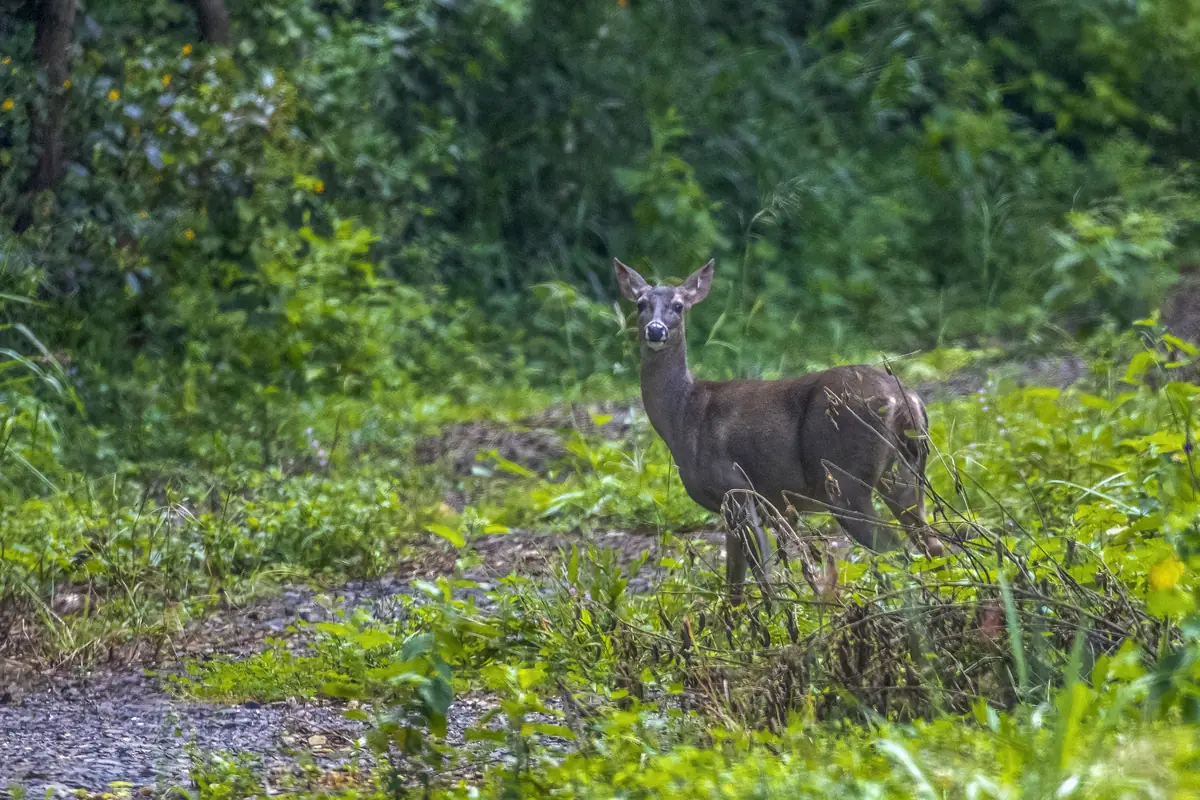
White-tailed deer — Costa Rica’s national animal, and one of the species counted arriving at those water holes. Photo: Arturo Bullard / Hotel Hacienda Guachipelín (used with permission)
That is the mechanism. Not better visibility — higher concentration. And it changes your tactics completely: in the dry season you do not wander looking for animals, you find water and wait.
The season itself, from Costa Rica’s national meteorological service and for the Pacífico Norte specifically: the dry period runs December to March and delivers just 4% of the year’s rain. April is a transition month. A first wet period from May to August brings 50%, interrupted in July and August by the *veranillo* — a reliable dry spell when the trade winds strengthen again. The remaining 46% falls between September and November, with September and October the wettest months of the year.
A myth worth retiring
Intact old-growth dry forest is not entirely deciduous — something like forty tree species in it stay green. The completely bare, leafless look in the photographs is characteristic of degraded secondary forest, not of healthy dry forest. If your guide takes you somewhere that still has green in March, you are in better forest, not worse.
And one small correction on timing: the popular claim that howler monkeys reliably howl at dawn is not actually established for the mantled howler — the research on close relatives points the other way. What you can plan around is that primate activity generally peaks in the morning, roughly six to midday, and again from mid-afternoon. An early start is still the right call; just not because of a dawn chorus that may not be a real thing.
What “sanctuary” means in Costa Rican law
This section exists because four of the five sloth day trips we sell use the word *sanctuary*, and almost every visitor reads that word to mean something it does not mean here.
Costa Rica’s wildlife regulations set out an exhaustive list of the kinds of wildlife site the state can authorise — the text uses the word *únicamente*, only. There are five: a rescue centre, a zoo, a breeding facility, an artisanal breeding facility, and an aquarium. That is the whole list. There is no sixth category called “sanctuary”, and the word appears in the regulations only as a non-commercial sub-type of zoo.
And that sub-type is drawn tightly. A *zoológico no comercial tipo santuario* may exhibit only animals that cannot be released, because of physical or behavioural damage caused by people — and it may not buy, sell, breed or exchange wild animals at all. So the word does mean something real here. It just means something far narrower, and far harder to qualify for, than anyone reads into it on a tour listing.
And the rules for a rescue centre are the part that surprises people. Under the regulations a rescue centre is non-profit, and is explicitly not authorised to exhibit animals and not open to the public.
No estarán autorizados para la exhibición ni reproducción de los animales silvestres, ni estarán abiertos al público.
— Reglamento a la Ley de Conservación de la Vida Silvestre, on rescue centres
Follow that through. If you can buy a ticket and go and look at the animals, then whatever the sign says, the facility is not legally operating as a rescue centre — because a rescue centre is not allowed to sell you that. In legal terms, a ticketed attraction that exhibits wildlife is a zoo.
This is not an accusation about anywhere in particular
A zoo is a lawful, regulated thing to be, and plenty of good ones do real conservation work. We are not saying any specific facility is unlicensed, badly run or unkind to its animals — we have no evidence of that about anywhere, and as the next section explains, no visitor is in a position to check. The point is narrower and it is about language: “sanctuary” and “rescue” are marketing words here, not legal statuses, and you should not read reassurance into them that they do not carry.
On handling the animals, the regent biologist at the Rescate Wildlife Rescue Center put it plainly to *El Colectivo 506*: “It’s forbidden to touch or manipulate wild animals, even if you’re a zoo. As a tourist, you should never be allowed to touch an animal… and sometimes it’s complicated, because people want that.”
In fairness we should say exactly how solid that is in the regulations. There is a sentence in the decree reading “no se permitirán manipulaciones a la fauna silvestre por visitantes, voluntarios, turistas y similares” — no handling of wildlife by visitors, volunteers or tourists. But it sits inside an article headed *Uso de animales silvestres en actividades audiovisuales*, about filming and photography, so how far it reaches beyond a film set is arguable. We would rather tell you that than overstate it. The practical signal is not arguable: if an attraction offers to put a sloth in your arms, that tells you something about the place whatever the sign outside says.
The register that would let you check doesn’t exist
Here is the part that genuinely surprised us, and it is not the operators’ fault.
Costa Rica’s wildlife statute creates a National Wildlife Register and requires it to be “público y de fácil acceso” — public and easily accessible — and to be shared with public institutions and with anyone who asks for it. That has been the law since the article was reformed in 2012. But the regulation that implements it still describes the public platform meant to hold that register in the future tense: *se desarrollará*, it will be developed.
Two regent biologists — one of them at an accredited rescue centre in Cañas, here in Guanacaste — told *El Colectivo 506* that no updated online list of compliant centres exists for travellers to consult, which leaves the burden of asking questions entirely on the tourist.
So the law says you have a right to check, and in practice there is nothing to check against. You cannot look up whether the place you are about to visit is licensed as a zoo, a rescue centre, or anything at all. Neither can we. That absence is the single most important thing in this guide, and it is a failure of the state, not of any particular business.
One thing you *can* verify is third-party accreditation, because those bodies publish complete public lists. Three facilities in Costa Rica hold accreditation from the Global Federation of Animal Sanctuaries, and two of them are in Guanacaste:
Centro de Rescate Las Pumas — Cañas, Guanacaste. Accredited since November 2017.
International Animal Rescue Costa Rica — Nosara, Guanacaste. Accredited December 2025.
Rescate Wildlife Rescue Center — Alajuela. Accredited since December 2011.
That list carries more weight than a voluntary industry badge normally would, because Costa Rica’s own regulations reach for it: the decree requires a rescue centre seeking certain designations to hold “la acreditación internacional de la Federación Global de Santuarios de Animales (GFAS)”. The state has effectively borrowed part of its standard from this private body — while still not publishing the register that would let you check the state’s own half.
Read that list correctly
The absence of a facility from an accreditation list is not evidence that it treats animals badly. Accreditation is voluntary and expensive, and these standards are written around non-exhibiting sanctuary models — a commercial visitor attraction may never have applied, and would not necessarily qualify if it did, without any of that reflecting on its animal care. Presence on the list is positive evidence. Absence from it is simply no evidence either way.
You may also see Costa Rica’s CST certification — Certificación para la Sostenibilidad Turística — displayed by wildlife attractions. It is real and genuinely government-issued, and worth something. But be clear what it certifies: tourism sustainability, assessed across things like water, energy, waste and community impact. It is not an animal-welfare audit and does not claim to be.
How to choose a wildlife experience here
Given all of the above, this is what we would actually do.
Decide whether you want wild animals or guaranteed animals. Both are legitimate. A facility gives you a certain sloth; a forest gives you a possible one. The problem is only when a facility is sold as a forest.
Treat a guarantee as information. If a listing promises a wild animal “100% guaranteed”, that is telling you the animal cannot leave. Take it as a description of the product rather than a red flag — but do not then expect a wild encounter.
For genuinely wild watching, go up. Rincón de la Vieja’s wet slope is where the toucans and the occasional sloth are, and it is a normal day trip from every beach town on this coast.
In the dry season, go where the water is. A guide who knows which water holes are still holding will show you more than one who walks you through pretty forest.
Start early. Primate activity peaks in the morning and again in the late afternoon; midday is the dead zone.
Ask what a “sanctuary” is licensed as. A straightforward operator will tell you. There is nothing wrong with the answer being “a zoo”.
Don’t hold the wildlife. Handling is not permitted, and a place that offers it is telling you something.
Bring binoculars. Dry forest is open enough that binoculars genuinely change the day, and almost nobody packs them.
Turtles are their own subject
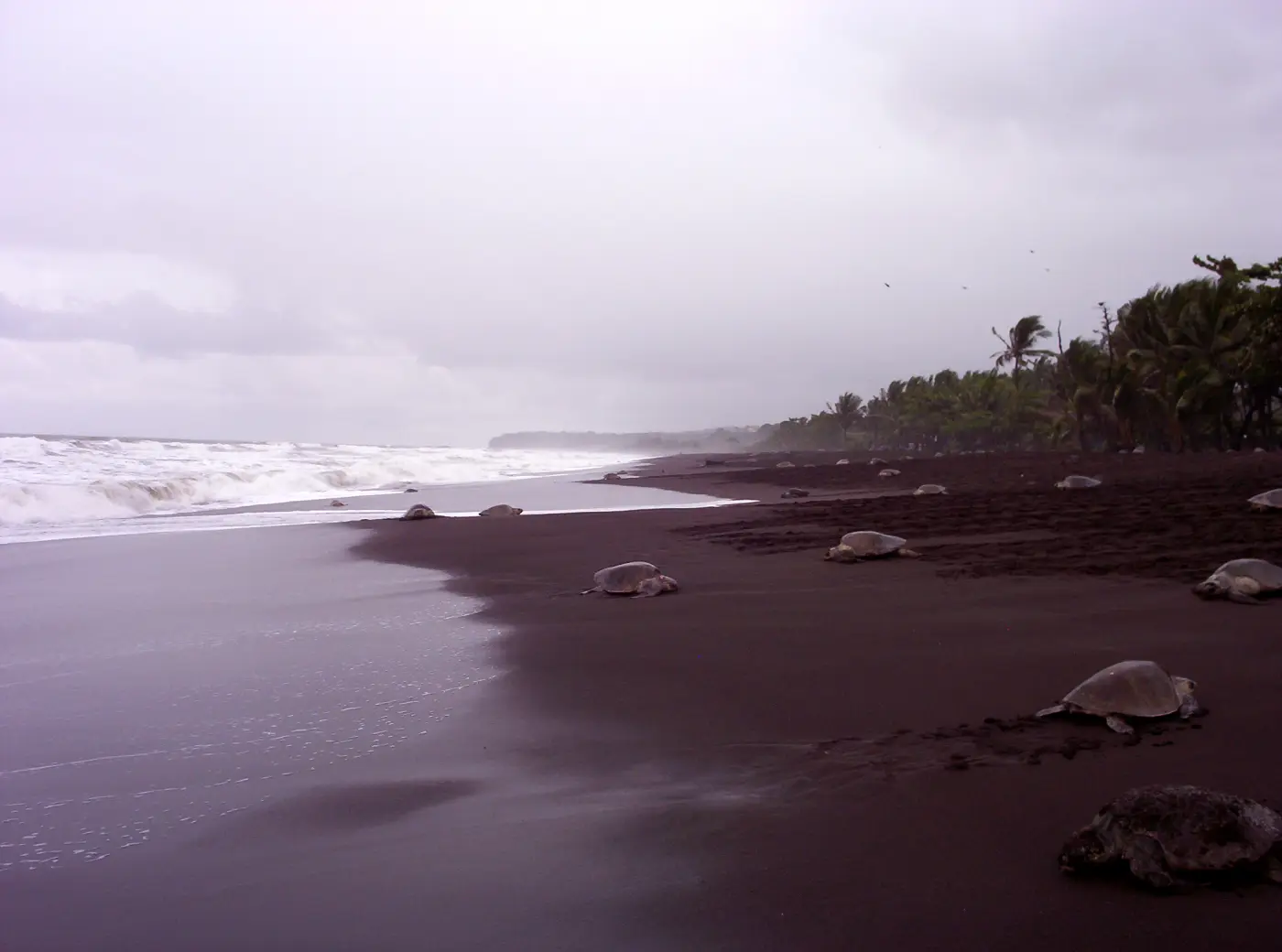
Guanacaste’s most famous wildlife spectacle is sea turtle nesting, and it needs more space and more care than a section here — the seasons, the rules, the guide requirements and one very important piece of expectation-setting about leatherbacks at Las Baulas, whose nesting numbers have collapsed. We have written that separately: see our guide to sea turtle nesting in Guanacaste.
The honest summary
Guanacaste’s Pacific lowlands are dry forest, and dry forest is a rare and genuinely interesting ecosystem with fewer species than the rainforest elsewhere in the country. You will very likely see monkeys, motmots, iguanas and coatis. You will not see a red-eyed tree frog. You will see a toucan if you drive up Rincón de la Vieja. You will probably only see a sloth at a facility, and that facility is legally a zoo no matter what the sign says — which is fine, as long as you know that is what you booked.
None of that is a reason to lower your expectations of a wildlife day here. It is a reason to point them in the right direction.
Can I see sloths in Guanacaste?
Not realistically in the wild on the coast. The IUCN Red List authority calls Hoffmann’s two-toed sloth “rare or absent in lowland dry forest”, and there is no voucher specimen of either sloth species from Guanacaste province in the global biodiversity record. Sloths occur sparsely on the wet slopes of Rincón de la Vieja. The reliable way to see one from a Guanacaste base is a day trip inland, usually including a wildlife facility.
Are there toucans in Guanacaste?
Yes, but not at the beaches. Keel-billed toucans are well reported on the wet upper slopes of Rincón de la Vieja and hardly ever in the dry coastal lowlands — in public birding records they turn up around fifty times more often at Rincón than at Tamarindo or Papagayo. Rincón de la Vieja is a standard day trip from every beach town on this coast.
Will I see a red-eyed tree frog?
Not in Guanacaste’s dry forest. A 2023 amphibian survey in the Área de Conservación Guanacaste recorded 660 individuals from 37 species; in the dataset published with it the red-eyed tree frog appears zero times at either dry-forest site and once in the whole study, at the rainforest site — and the Santa Rosa sampling was statistically complete, so that is a characterised community rather than a gap in the fieldwork. The tree frogs that genuinely live here are the Mexican tree frog and the milk frog.
What is the best time of year for wildlife in Guanacaste?
The dry season, roughly December to March, but not for the reason usually given. There is no evidence that bare trees make animals easier to spot; what is documented is that scarce water concentrates animals at the remaining water holes, where researchers have counted hundreds of coatis and peccaries at a single site over a few weeks. Find water and wait.
Is a “sloth sanctuary” a rescue centre?
Legally, almost certainly not. Costa Rican regulations list five authorised categories of wildlife facility, and “sanctuary” is not one of them — it appears only as a non-commercial sub-type of zoo. A rescue centre is explicitly not permitted to exhibit animals or open to the public, so any ticketed attraction you can visit is operating as a zoo. That is lawful and can be perfectly good; it just is not what most visitors think the word means.
How can I check whether a wildlife attraction is licensed?
Realistically you cannot, and that is not the operators’ fault. Costa Rican law creates a National Wildlife Register and requires it to be public, easily accessible and shared with anyone who asks — but the regulation implementing it still describes the public platform in the future tense, and no usable public list exists. What you can check is voluntary third-party accreditation: three Costa Rican facilities hold Global Federation of Animal Sanctuaries accreditation, two of them in Guanacaste. Absence from that list is not evidence of poor welfare.
Does CST certification mean the animals are well treated?
No. CST is a real, government-issued certification and worth something, but it assesses tourism sustainability — water, energy, waste, community impact — not animal welfare. Treat it as evidence of a well-run tourism business, not of an audited animal-care standard.
Is Guanacaste rainforest or dry forest?
Both, at different altitudes. The Pacific lowlands where the beach towns are is tropical dry forest — a rare ecosystem of which, by Janzen’s assessment, less than 2% of the original Mesoamerican extent is still sufficiently intact to interest a conservationist. But the province rises to nearly 1,900 metres, and the Área de Conservación Guanacaste contains four of the five main tropical ecosystem types, including a sector officially named Rincón Rain Forest. Which forest you are standing in decides which animals you can see.
Sources
Facts in this guide were checked against these references on the dates shown.
Decreto Ejecutivo 40548-MINAE — Reglamento a la Ley de Conservación de la Vida Silvestre — Article 84 authorises “únicamente” five categories of wildlife-management site: centros de rescate (non-profit), zoológicos, zoocriaderos, zoocriaderos artesanales and acuarios — an exhaustive list containing no category called “santuario”. Article 100 defines rescue centres and states: “No estarán autorizados para la exhibición ni reproducción de los animales silvestres, ni estarán abiertos al público.” Definition 60 and Article 107 define “zoológicos no comerciales tipo santuario” as permitted to exhibit only animals that cannot be released owing to physical or behavioural harm caused by human action, and prohibited from buying, selling, breeding or exchanging wild animals. Article 196 states that the Sistema Nacional de Información sobre Vida Silvestre — the public platform for the Registro Nacional de Vida Silvestre created by article 19 of the Ley — “se desarrollará” as a public, easily accessible, updated virtual platform: future tense. Article 99 requires a rescue centre seeking certain designations to hold “la acreditación internacional de la Federación Global de Santuarios de Animales (GFAS)”. The decree also contains, once, the sentence “No se permitirán manipulaciones a la fauna silvestre por visitantes, voluntarios, turistas y similares” — but it sits inside Article 49, headed “Uso de animales silvestres en actividades audiovisuales”, in the section on uses of wildlife, so this guide does not present it as a general visitor-conduct rule and says so in the text. Quoted from the Comisión Nacional para la Gestión de la Biodiversidad copy, whose text extracted cleanly (242 article headings as a grep control); the SINAC ministry copy corroborates Article 84 and Definition 60 but uses a glyph-substitution font. The canonical SCIJ/SINALEVI page for this norm renders its text client-side and contains zero occurrences of “40548” in the delivered HTML, so it is not cited as the checked source. (accessed 23 September 2026)
Ley 7317 — Ley de Conservación de la Vida Silvestre, article 19 (as reformed by Ley 9106 of 20 December 2012) — Article 19 creates the Registro Nacional de Vida Silvestre within SINAC and states that the register “será público y de fácil acceso y deberá compartirse con las instituciones públicas y con cualquier persona que así lo solicite.” Its stated function is the registration and control of wildlife held at management sites and in private hands. The article carries the note “Así reformado por el artículo 1° de la ley N° 9106 del 20 de diciembre de 2012”. Note that the register itself is created in the present tense by this statute; it is the implementing platform in the 2017 regulation that is future tense. The PDF uses a glyph-substitution font and was decoded before quoting; SINAC’s server presents an incomplete certificate chain. (accessed 23 September 2026)
Global Federation of Animal Sanctuaries — Find a Sanctuary (accredited and verified organisations) — The complete public directory. Three Costa Rican facilities hold full GFAS Accredited status: Centro de Rescate Las Pumas (Cañas, Guanacaste), accredited 2017-11-20; International Animal Rescue Costa Rica (Nosara, Guanacaste), accredited 2025-12-03; and Rescate Wildlife Rescue Center (Alajuela), accredited 2011-12-12. Each date was confirmed on that facility’s individual profile page. GFAS accreditation is voluntary and its standards are written around non-exhibiting sanctuary models, so absence from this list is not evidence about any facility’s animal welfare — a point this guide states explicitly. The directory’s map coordinates for two of the three are the Costa Rica country centroid, a geocoder fallback, not real locations. (accessed 23 September 2026)
IUCN SSC Anteater, Sloth and Armadillo Specialist Group — Hoffmann’s two-toed sloth (Choloepus hoffmanni) — The Red List Authority’s species profile: “In Central America, it occurs in evergreen and semi-deciduous tropical moist forest, as well as in secondary forest, but it is rare or absent in lowland dry forest.” The corresponding Red List assessment is Choloepus hoffmanni, The IUCN Red List of Threatened Species 2022: e.T4778A210443596. The wording was checked here rather than on iucnredlist.org, which returns HTTP 403 to automated clients and for which the Internet Archive holds no usable snapshot of the assessment text — this guide therefore attributes the wording to the specialist group that authors the assessment. (accessed 23 September 2026)
Edwards et al. (2023) — “Amphibian diversity across three adjacent ecosystems in Área de Conservación Guanacaste, Costa Rica”, PeerJ 11:e16185 — Surveys between August and November 2017 recorded “660 individual amphibians from 37 species”, all anurans. Table 2 gives Santa Rosa observed richness of 6 species with a Chao1 estimate of 6 — 100% sampling completeness, the highest of the five sites — so the dry-forest amphibian community is characterised rather than under-sampled. The red-eyed tree frog (Agalychnis callidryas) is not named in the article text; its counts come from the authors’ own deposited dataset at https://github.com/xavharrison/CostaRica_RankAbundance_2022 (data.csv), which records zero individuals at both dry-forest sites (Santa Rosa, Murciélago), zero at Maritza and Cacao, and one individual at the rainforest site San Gerardo — one in the entire study. The journal’s own article page returns HTTP 403 to automated clients and the supplementary species table is unreachable, so the deposited dataset the paper’s analyses run on was used instead. DOI 10.7717/peerj.16185. (accessed 23 September 2026)
Vaughan, C. & Weis, K. (1999) — “Neotropical dry forest wildlife water hole use and management”, Revista de Biología Tropical 47(4): 1039–1044 — Between 8 March and 28 April 1990 all mammal species and one game bird visiting two Guanacaste dry-forest water holes were counted between 06:00 and 18:00. Table 1 gives, at the natural water hole (Quebrada Duende): coati 221, spider monkey 122, collared peccary 116, great curassow 115, white-tailed deer 65, capuchin 271 (15.1 per day); and at the artificial water hole: coati 191, peccary 179, capuchin 277 (15.4 per day), deer 66. Totals were 919 and 713 individuals. This is the documented mechanism behind dry-season wildlife watching — concentration at remaining water — as distinct from the widely repeated but unevidenced claim that leafless trees improve visibility. Caveat: the paper’s prose states that agouti, spider monkey and great curassow “used only AW”, which contradicts its own Table 1, where those three appear at QD and not AW; the table is self-consistent with the stated totals, so figures here are attributed to the natural water hole per the table. (accessed 23 September 2026)
El Colectivo 506 — “How can travelers choose an ethical wildlife sanctuary in Costa Rica?” (21 April 2022) — Marta Venegas, regent biologist of Rescate Wildlife Rescue Center – Zooave, is quoted: “It’s forbidden to touch or manipulate wild animals, even if you’re a zoo… As a tourist, you should never be allowed to touch an animal… and sometimes it’s complicated, because people want that.” The article also states that “no updated online list of centers that comply with these requirements exists for travelers to consult” — attributed jointly to Venegas and to Esther Pomareda, regent biologist of Centro de Rescate y Santuario Las Pumas in Cañas, Guanacaste — “so the onus is on the tourist to ask questions.” It further notes that rescue centres cannot be exhibited to the public. Dated caveat: the companion article states Costa Rica then had three GFAS-accredited sanctuaries including Kids Saving the Rainforest (Quepos), which does not appear on the 2026 GFAS list; the roster has changed and the two are not blended here. (accessed 23 September 2026)
Instituto Meteorológico Nacional — Clima de la Región Pacífico Norte de Costa Rica — The national meteorological service on this region specifically: “el período seco va de diciembre a marzo. En este período precipita un 4% del total de lluvia anual”, with April a transition month; a first wet period May–August contributing 50%, within which “entre julio y agosto, los vientos Alisios vuelven a intensificarse y como consecuencia se presenta el veranillo del Pacífico o canícula”; and “un segundo período lluvioso se extiende desde setiembre hasta noviembre… El 46% de la lluvia anual, precipita en este segundo período lluvioso”, September and October contributing most. Figure 2 labels the split 4% / 50% / 46%. Reference climatology 1961–1990; regional annual rainfall 1,500–2,500 mm. Note: the IMN’s general national climate publication does not contain the 4% figure and its bimodal-rainfall passage describes the Caribbean slope, so it is not used here. (accessed 23 September 2026)
Guanacaste Dry Forest Conservation Fund — The Dry Forest — Lists characteristics of tropical dry forest, including: “For any given taxonomic group, the number of species is 50-80% lower than for the same taxon in the adjacent rain forest.” Also states that by 1985 “less than 0.02% of Mesoamerican dry forest was intact and had some kind of protected status.” This guide flags in the text that the 50–80% figure conflicts with Janzen’s own published estimate below, and attributes both rather than presenting them as agreeing. (accessed 23 September 2026)
Janzen, D.H. (1988) — “Tropical Dry Forests: The Most Endangered Major Tropical Ecosystem”, in E.O. Wilson (ed.), Biodiversity, National Academy Press, ch. 14, pp. 130–137 — States that when the Spaniards arrived there were “550,000 square kilometers of dry forest… on the Pacific coast of Mesoamerica” (Panama to western Mexico), and that “Today, only 0.09% of that region (approximately 480 square kilometers) has official conservation status, and less than 2% is sufficiently intact to attract the attention of the traditional conservationist.” This guide uses the “less than 2% sufficiently intact” figure and describes the 0.09% accurately as protected status rather than as what survives — the two are different claims and are often conflated. The same chapter states that dry forest adjacent to rain forest sustains a flora and fauna “about 50 to 100% as species-rich” as the neighbouring rain forest, which conflicts with the GDFCF figure above; both are attributed in the text. This host serves 200 for nonsense paths, so the page was verified by content — the chapter title, author line and page-130 marker were confirmed in the retrieved text. (accessed 23 September 2026)
Área de Conservación Guanacaste — Programa de Sectores — ACG’s own site names one of its management sectors “Sector Rincon Rain Forest”, confirming in the protected area’s own words that rainforest exists within Guanacaste — the basis for this guide’s correction of the common claim that the province is uniformly dry forest. Verified by content from ACG’s site navigation: this host returns HTTP 200 for nonsense paths, so status codes prove nothing about it, and its server presents an incomplete certificate chain. Prior research also found injected spam content on at least one page of this site, so nothing here rests on its prose beyond the sector name. (accessed 23 September 2026)
GBIF — Global Biodiversity Information Facility, occurrence records — The comparative figures for keel-billed toucan and turquoise-browed motmot in this guide are our own analysis of public occurrence records, expressed as reports per 10,000 bird records from each area, with the motmot serving as a survey-effort control. They describe how often birdwatchers report a species, not abundance or population density, and are presented as such. The absence of any voucher specimen of either sloth species from Guanacaste province is likewise a query result rather than a published finding. Coastal Guanacaste sloth records exist but coincide with the locations of wildlife facilities and adventure parks, and their captive or wild status is undetermined, so this guide explicitly declines to cite them as evidence of wild occurrence. (accessed 23 September 2026)
Plan this trip
Browse the tours that fit what you’ve just read — real operators, real prices, book direct.
Browse wildlife & nature tours in Guanacaste