Wildlife & Nature
Sea Turtle Nesting in Guanacaste: Where to Go and How to Watch Responsibly
Guanacaste Experiences editorial team
·
19 September 2026
·
10 min read
In this guide
Which turtles nest where, and whenOstional: the arribadasThe practicalitiesWhy the egg harvest here is legalLas Baulas and Playa Grande: the honest situationGuided night tours near TamarindoTwo other beaches worth knowing aboutThe rules, and why they existWhy light is the whole issueWhy you shouldn’t handle hatchlingsHow to choose an operatorFrequently asked questionsGuanacaste’s one dependable turtle spectacle is the olive ridley arribada at Ostional, where 15,000 to 200,000 females come ashore over a few nights, once or twice a month, all year. Near Tamarindo, guided night tours walk beaches outside the national park for olive ridleys and East Pacific green turtles, roughly mid-November to mid-April. Leatherbacks are the exception: Las Baulas National Marine Park exists for them, but SINAC’s own page says there is no turtle observation there, and the park’s leatherback tour has been suspended since 2018.
What this guide is, and isn’t
Every season, rule and fee below comes from SINAC’s park pages, the conservation groups working these beaches and Costa Rican news reports, all checked on 19 September 2026. Nesting seasons are windows, not promises: nobody can guarantee you a turtle. For the wider calendar, see our Guanacaste month-by-month guide.
Which turtles nest where, and when
Seasons reported by SINAC, the Leatherback Trust, WCA Nosara and the operators listed in our catalog. Windows shift from year to year.
Species
Where in Guanacaste
When
How you can see it
Olive ridley (arribada)
Ostional refuge
Year-round, once or twice a month; biggest Jul–Nov, peak Sep–Oct
Only with an accredited local guide, groups of nine
Olive ridley (solitary)
Beaches north of Playa Grande; Junquillal; Cabuyal
Tamarindo tours mid-Nov–mid-Apr
Licensed night tour
East Pacific green (“black”)
Las Baulas; Cabuyal and Papagayo; Junquillal
Cabuyal season 15 Sep–31 Mar; Tamarindo tours mid-Nov–mid-Apr
Licensed night tour outside the park
Leatherback
Playa Grande, Ventanas, Langosta
1 Oct–15 Mar (park limits beach stays Oct–Feb)
No observation offered; sightings now very rare
Hawksbill
Junquillal and Cabuyal
Recorded, but rare
Not bookable; a chance encounter at best
Ostional: the arribadas
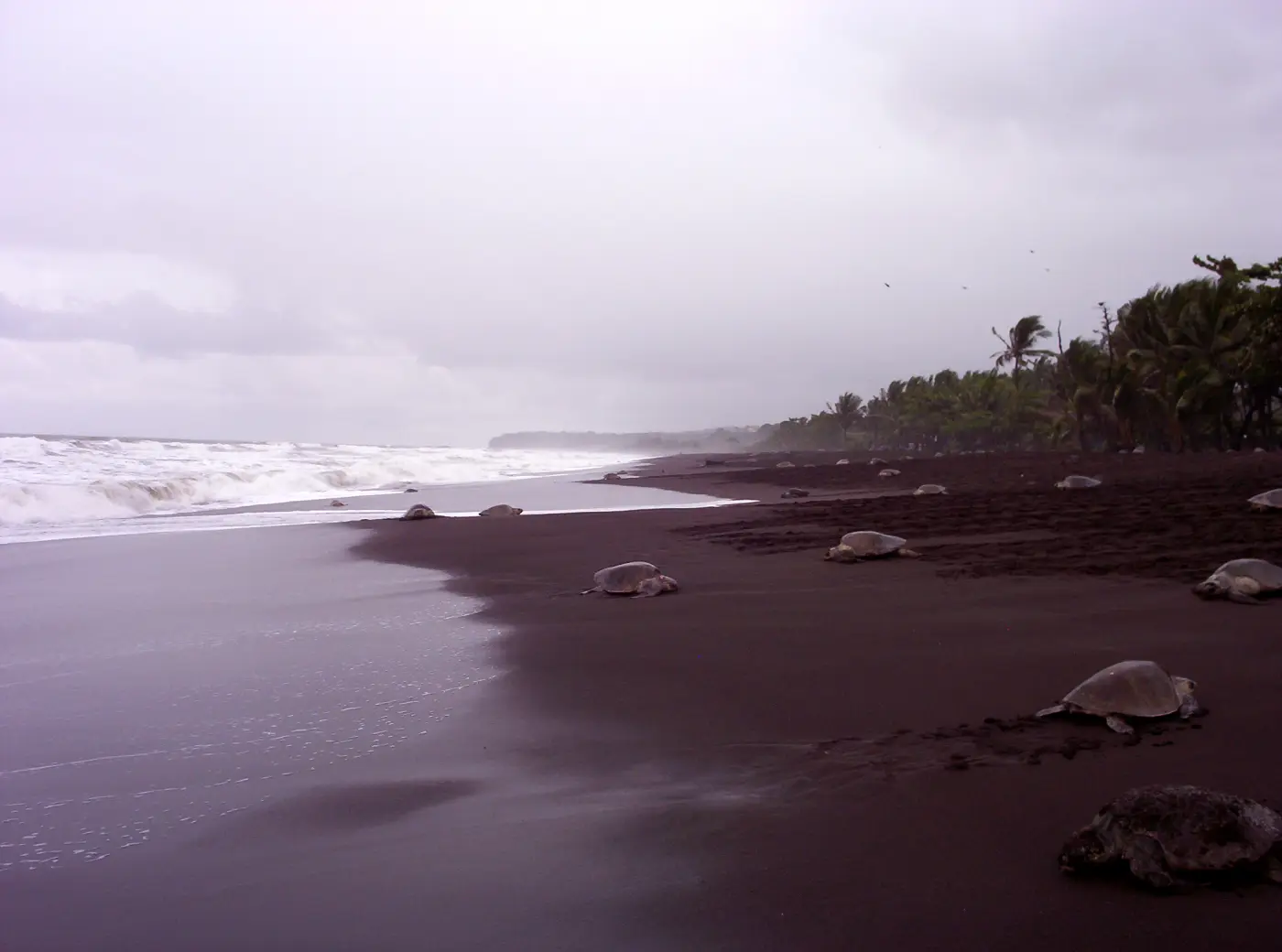
The Ostional National Wildlife Refuge covers four beaches — Ostional, Nosara, Pelada and Guiones — and protects the world’s most important olive ridley nesting site, second only to Playa Escobilla in Mexico for mass nesting. The arribadas crowd into roughly 800 metres of a seven-kilometre beach.
They happen all year, once or twice a month, and bring 15,000 to 200,000 females ashore. The rainy-season events from July to November are the big ones: Nosara’s Wildlife Conservation Association says September and October arribadas can bring up to half a million turtles and run three to four days, against tens of thousands over two or three nights from December to June. In early September 2026 the local guides’ association announced an arribada starting Friday 5 September, expected to last five to six nights with the first three busiest.
Nobody knows in advance when the next one starts. For a realistic chance, base yourself in Nosara for several nights in the rainy season and follow the guide associations.
The practicalities
Hours and fees: open daily 5am to 9pm; entry is ₡1,808 for residents and US$13.56 for non-residents. Fees change — check SINAC’s page before you go.
Guide: during an arribada you may only enter the beach with a local tourism guide, and that fee is a separate private service, not included in entry. SINAC names the Ostional guides association (AGLO) and development association (ADIO) as contacts.
Group size and time: access closes to anyone without a certified guide, groups are capped at nine, and time on the sand is deliberately limited.
Getting there: Ostional is a long way from the north-coast beach towns, on roads that worsen in the rainy season. Our transport guide covers the options.
Why the egg harvest here is legal
Ostional is one of very few places on earth with a legal, regulated take of sea turtle eggs, and visitors are often startled by it. The reasoning is density: so many females nest in the same strip of sand that later arrivals dig up nests laid days earlier, and broken eggs lower hatching success for everyone. Members of ADIO may collect a share of the eggs in the first days of an arribada, under permits, environmental controls and traceability rules. In return the community protects the beach and patrols against poaching.
Outside that system, taking eggs is a crime: on 7 September 2026 two people who did not belong to ADIO were detained with 125 olive ridley eggs from about two nests. Don’t buy eggs, and don’t pick one up on the sand.
Las Baulas and Playa Grande: the honest situation
Las Baulas National Marine Park was created to protect the leatherbacks nesting at Playa Grande, Playa Ventanas and Playa Langosta, and three species still visit: leatherback, olive ridley and the black turtle. It opens daily 6am to 6pm, and in the October–February nesting season you must be off the beach by 5pm. Its two entrances take a combined 120 people, 60 per gate.
Now the part most articles skip. SINAC’s page for the park currently states, in plain Spanish, that there is no turtle observation, and that estuary visits are made with local guides, no booking needed. The leatherback nesting season runs 1 October to 15 March, but only eight nesting leatherbacks were identified in the park in 2021–22, and fewer than ten now come in a whole season — residents remember 30 to 40 a night in the late 1980s. The Eastern Pacific population has fallen by more than 98% since 1990. The park suspended guided viewing shortly before the pandemic, and the published tour procedure has carried a “suspended since 2018” notice ever since.
So if a website offers you a leatherback tour at Playa Grande, treat it as out of date. What you can do here is walk and surf the beach by day, and take a guided trip through the mangroves: the Tamarindo estuary boat safari runs two hours inside the park, from $52 per person. Dogs, single-use plastics, fires, beach vehicles and horse rides are banned, as is touching or feeding any animal.
Guided night tours near Tamarindo
Because the park tour stopped, guiding moved to beaches outside it. RipJack Inn at Playa Grande says tours now visit nearby protected beaches such as Playa Minas, with an official season of 15 October to 15 February — which doesn’t match the operators’ own windows, a reminder that these are ranges, not timetables. Two night tours in our catalog leave from Tamarindo:
[Night turtle nesting tour from Tamarindo](/tours/night-turtle-nesting-tour-from-tamarindo) — four hours, from $46 per person. The guide walks remote beaches just north of Playa Grande for olive ridley and Pacific green turtles. Torches and camera flash are prohibited and the guide carries a special red light. No children under 5, because the group has to stay quiet and still for long stretches. Listed season mid-November to mid-April; six people are needed for it to run.
[Turtle watching night tours with an expert naturalist](/tours/turtle-watching-night-tours-with-expert-naturalist) — four hours, from $75 per person, on beaches north of the leatherback park, where the listing says up to three species are possible. This listing includes “flashlights”: ask the operator to confirm they are red-filtered and guide-operated before you book.
Expect a lot of waiting and a real chance of seeing nothing. Prices are “from” prices per person in our catalog in September 2026 and change. For how a turtle night fits into a Tamarindo week, see our day trips from Tamarindo.
Two other beaches worth knowing about
Playa Junquillal, south of Tamarindo: Fundación Verdiazul runs a hatchery here and patrols four beaches every night, about 12 km of coast. Leatherback, olive ridley, black and hawksbill turtles all nest in the area, and the foundation takes environmental volunteers.
Playa Cabuyal, in the Gulf of Papagayo: an important secondary nesting beach for East Pacific leatherbacks, monitored by the Leatherback Trust since 2011. Leatherback, olive ridley and East Pacific green turtles nest regularly, hawksbills rarely; the field season runs 15 September to 31 March.
Neither is a drop-in attraction. Both are working conservation projects — contact them well ahead rather than turning up.
The rules, and why they exist
Non-negotiable on any nesting beach
No flash photography and no white torches — both are banned at Ostional, and a startled female abandons the attempt and returns to the sea without laying. No reflective clothing at night. Enter an arribada beach only with an accredited local guide, in a group of nine or fewer. Don’t touch, approach or handle a turtle or a hatchling, and never pick one up “to help it”. No vehicles, quad bikes, horses, dogs or fires on the sand. Let the guide decide where everyone stands, and when a light goes on.
Why light is the whole issue
Hatchlings find the sea by crawling toward the brightest horizon. On a dark beach that is the water; near lights it is the road, where they are eaten, run over or die of exhaustion. Adult females misorient toward lights or crawl in circles, and many give up. SINAC puts it directly on the Ostional page: light can frighten a female into abandoning the nest she has started, leaving the eggs uncovered for predators.
Red light is less disruptive, not harmless. Conservation groups that work nesting beaches are blunt: red spectrums still have real potential to change turtle behaviour, and species react differently. The light belongs to the guide, not to you.
Why you shouldn’t handle hatchlings
The crawl from nest to sea is not a formality the turtle can skip. NOAA Fisheries’ guidance is not to swim with, ride, approach, touch or interact with wild sea turtles, and to watch from far enough away that a turtle’s whole body fits between your fingers at arm’s length. Only permitted researchers handle turtles, nests or hatchlings. If an “experience” offers to put a hatchling in your hand, leave.
Two smaller habits matter more than they sound: fill in the holes you dig and flatten sandcastles, because hatchlings fall in and females get stuck, and clear chairs, umbrellas and canopies off the beach at night.
How to choose an operator
At Ostional, book through the refuge’s own channels. SINAC names AGLO and ADIO, and asks visitors to contract tourism services through the guide associations, tour operators and local organisations that back them.
Check the guide is accredited. Costa Rica regulates tourist guides under Decreto Ejecutivo N°41369 MEIC-TUR (2018). The ICT issues credentials as General, Local, Specialized or Adventure guides — Local guides work inside SINAC conservation areas — and publishes an updated list. Ask to see a carné.
Ask about light before you pay. A good answer is a red light carried by the guide, used sparingly. A bad answer is “bring your torch”.
Be suspicious of guarantees. Anyone promising you turtles, or promising hatchlings, is either misinformed or not planning to follow the rules.
Prefer small groups. Nine is the cap at Ostional for a reason, and a good ceiling anywhere. No legitimate operator lets guests hold hatchlings, dig up nests or pose with a nesting female.
If your dates miss every turtle season, Guanacaste still has good wildlife days: a guided hiking and birdwatching walk in Nosara (1.5 hours, binoculars and telescope provided, from $65) or a safari float on the Nosara River (2 hours, from $70). Our dry vs. green season guide helps you pick dates.
Browse wildlife & nature tours
Turtle nights, estuary safaris, birding walks and river floats across Guanacaste. “From” prices are from September 2026 and change — the tour page shows the current rate.
Frequently asked questions
When is the best time to see turtles nesting in Guanacaste?
It depends on the turtle. Ostional’s olive ridley arribadas happen all year, once or twice a month, but the biggest come in the rainy season from July to November, peaking in September and October. Guided night tours from Tamarindo for olive ridley and Pacific green turtles run roughly mid-November to mid-April. Leatherback season at Las Baulas is 1 October to 15 March, but leatherbacks are now extremely rare there.
Can I visit Ostional during an arribada without a guide?
No. SINAC states that during an arribada you may only enter the beach with a local tourism guide, and reports from the September 2026 arribada describe access closing to anyone without a certified guide, with groups capped at nine. The guiding fee is separate from entry (₡1,808 for residents, US$13.56 for non-residents).
Can you still see leatherback turtles at Playa Grande?
Not on a tour. SINAC’s page for Las Baulas says there is no turtle observation, and the park’s leatherback tour has been suspended since 2018 because so few leatherbacks nest there — only eight were identified in 2021–22, and the Eastern Pacific population has fallen more than 98% since 1990. Treat a sighting as very unlikely.
Why is flash photography banned on turtle beaches?
Because light changes what turtles do. A female disturbed by light will often abandon the nest she has started and return to the sea, leaving eggs exposed. Hatchlings navigate toward the brightest horizon, so artificial light draws them inland, away from the water. Flash and white torches are explicitly prohibited at Ostional.
Is red light safe for sea turtles?
Safer, not safe. Red is less disruptive than white, which is why guides use it, but conservation groups warn that red spectrums still have real potential to disturb turtles, and species react differently. Carry no light of your own and let the guide use theirs sparingly.
Can I help release baby turtles in Guanacaste?
Not by picking them up. Handling hatchlings is for permitted researchers and project staff only, and NOAA’s guidance for wild sea turtles is not to touch, approach or interact with them. Projects such as Fundación Verdiazul at Playa Junquillal and the Leatherback Trust at Playa Cabuyal do take volunteers — but that means signing up for the work in advance.
Sources
Facts in this guide were checked against these references on the dates shown.
SINAC — Refugio Nacional de Vida Silvestre Ostional — The refuge covers Playas Ostional, Nosara, Peladas and Guiones (468 ha land, 8,000 ha marine) and protects the world’s main olive ridley nesting site; arribadas occur year-round, once or twice a month, over roughly 800 m of a 7 km beach, with 15,000–200,000 females; second most important such beach globally after Playa Escobilla, Mexico; open daily 5am–9pm; entry ₡1,808 for residents and US$13.56 for non-residents; during arribadas entry is obligatory with a local tourism guide, paid separately, and the page names the Ostional local guides association (AGLO) and the Ostional development association (ADIO); no reflective clothing at night, ask a guide how and when to use a torch because light can frighten a female into abandoning her nest; bans on motor vehicles and quad bikes, horse tours on the sand, litter, bonfires, flash photography at night and domestic animals. (accessed 19 September 2026)
SINAC — Parque Nacional Marino Las Baulas — The park was created to protect leatherbacks nesting at Playas Grande, Ventanas and Langosta; three turtle species visit it (leatherback Dermochelys coriacea, olive ridley Lepidochelys olivacea, black turtle Chelonia agassizii); the page states “No hay observación de tortugas y la visita al estero es a través de guías locales. No es necesario reservar”; open daily 6am–6pm, with beach stays only until 5pm in the October–February nesting season; two entrances with a combined carrying capacity of 120 people (60 per gate); bans on pets, single-use plastics, litter, fires, loud music, weapons, vehicles on the beach, horse rides and touching or feeding animals. (accessed 19 September 2026)
Ojo al Clima — Cambio climático, contaminación y pesca incidental amenazan a la tortuga baula (27 February 2023) — The leatherback nesting season at Parque Nacional Marino Las Baulas runs 1 October to 15 March; only 8 nesting leatherbacks were identified in the 2021–22 season and fewer than 10 now nest in a whole season; residents remember 30–40 leatherbacks a night in the late 1980s; the park administration was forced to suspend the guiding activity shortly before the pandemic. (accessed 19 September 2026)
Sostenibilidad en Grande — Leatherback turtle tour procedure — The published Las Baulas leatherback tour procedure is marked “SUSPENDED SINCE 2018 DUE TO LOW NUMBER OF LEATHERBACKS NESTING”; when it ran, groups were capped at 30, booking was required 8 days ahead, and visitors could wait up to 6 hours and watch only until the female began camouflaging the nest. (accessed 19 September 2026)
RipJack Inn (Playa Grande) — Turtle tours — Turtle tours inside Las Baulas Marine National Park at Playa Grande are no longer available under new regulations; guided tours now go to nearby protected beaches such as Playa Minas, for green and leatherback turtles, with an official season given as 15 October to 15 February. (accessed 19 September 2026)
The Tico Times — Thousands of olive ridley turtles come ashore in one of the year’s largest arribadas (4 September 2026) — A major arribada began at Ostional in early September 2026; September events can bring more than 100,000 turtles in a night, against fewer than 20,000 over three or four nights in the dry season; the development association can declare an arribada aprovechable at about 1,000 turtles and the legal harvest is limited to the first days, when later females dig up earlier nests; beach access closes to anyone not accompanied by a certified local guide, with groups capped at nine visitors; flash photography and white torches are prohibited; a startled female abandons the attempt and returns to the sea without laying. (accessed 19 September 2026)
La Nación — Video: ¡Ya están aquí! Inició una de las arribadas más grandes del año en Ostional (September 2026) — The Ostional local guides association reported the arribada beginning on Friday 5 September 2026 and expected to last five to six nights, with the first three nights concentrating the most nesting turtles; entry requires accompaniment by local guides, visitors go in small groups and time with the turtles is limited. (accessed 19 September 2026)
The Tico Times — Two detained with 125 sea turtle eggs during Costa Rica’s Ostional arribada (9 September 2026) — Two people were detained on the morning of 7 September 2026 taking 125 olive ridley eggs, from about two nests, without authorisation; the legal programme is open only to members of the Ostional development association (ADIO) and is subject to environmental controls, permits and traceability; taking eggs outside that system is illegal. (accessed 19 September 2026)
Wildlife Conservation Association (WCA Nosara) — Arribadas — The largest arribadas come in September and October, when up to 500,000 turtles nest at once; rainy-season events (July–November) involve hundreds of thousands of turtles and last 3–4 days, while dry-season events (December–June) involve tens of thousands and last 2–3 days. (accessed 19 September 2026)
Wildlife Conservation Association (WCA Nosara) — The Refuge — The refuge spans Ostional, Nosara, Pelada and Guiones, about 15 km of shoreline plus 3 nautical miles of sea; olive ridley, Pacific green and leatherback turtles nest there, olive ridleys most abundantly; it has the highest frequency of mass-nesting events on Earth, second only to Escobilla, Mexico; high nest density means later nests destroy earlier ones and lowers hatching success; the community harvests a small percentage of eggs during the first three days of an arribada and in exchange protects the beach and patrols for poachers. (accessed 19 September 2026)
The Leatherback Trust — homepage — Eastern Pacific leatherbacks are critically endangered and the population has declined by more than 98% since 1990. (accessed 19 September 2026)
The Leatherback Trust — Conservation — The Trust supports park rangers’ education programmes at the park and secondary nesting beaches nearby; it asks coastal residents to turn off lights, close curtains and use only exterior red lights at night; bottom trawlers discard up to nine times as much bycatch as shrimp caught; it encourages visitors to book tours with local guides and support the park’s ecotourism. (accessed 19 September 2026)
The Leatherback Trust — Playa Cabuyal Sea Turtle Biology Training Camp booklet (PDF) — Playa Cabuyal, in the Gulf of Papagayo, is an important secondary nesting beach for East Pacific leatherbacks; three species nest there regularly — leatherback, olive ridley and East Pacific green (black) turtle — with hawksbills a rare occurrence; the monitoring programme was established in 2011 and the field season runs 15 September to 31 March. (accessed 19 September 2026)
Fundación Verdiazul — Our work — Verdiazul protects leatherback, olive ridley, black (Chelonia mydas) and hawksbill turtles; its hatchery is at Playa Junquillal, Santa Cruz, Guanacaste; volunteers patrol four beaches every night, covering 12 km of coastline a day, and the foundation runs an environmental volunteering programme. (accessed 19 September 2026)
Sea Turtle Conservancy — Threats from artificial lighting — Hatchlings find the sea by heading for the brightest horizon, so lights from buildings and streets draw them inland where they are eaten, run over or drown; nesting females misorient toward lights or crawl in circles; the organisation’s guidance for coastal lighting is “Keep it Low, Keep it Shielded, and Keep it Long”, and it asks beach visitors to avoid portable lights. (accessed 19 September 2026)
Sea Turtle Preservation Society — Sea turtles and the red light myth — Red light is not harmless: specific red spectrums are less impactful but still have significant potential to disrupt sea turtle behaviour, and responses differ by species; the society advises avoiding artificial light on nesting beaches and joining an organised guided walk instead. (accessed 19 September 2026)
NOAA Fisheries — What can you do to help sea turtles? — Do not swim with, ride, approach, touch or attempt to interact with wild sea turtles; keep enough distance that the turtle’s whole body fits between your fingers held at arm’s length; turn off, shield or redirect lights visible from the beach; remove chairs, umbrellas and canopies at night and fill in holes and knock down sandcastles; join an organised turtle walk to watch without disturbing turtles, nests or hatchlings. (accessed 19 September 2026)
Instituto Costarricense de Turismo (ICT) — Guías de turismo — Tourist guides are regulated by Decreto Ejecutivo N°41369 MEIC-TUR of 16 November 2018; ICT issues credentials in the categories General, Local (working inside SINAC conservation areas), Specialized and Adventure, and publishes an updated list of accredited guides. (accessed 19 September 2026)
Guanacaste Experiences — tour pages (operator listings, September 2026) — Starting prices, durations, inclusions, age limits, minimum group sizes and operator notes for each linked tour as listed in this site’s catalog in September 2026, including the night turtle tour’s stated mid-November to mid-April season, its olive ridley and Pacific green turtle focus, its ban on torches and camera flash and the guide’s red light, and the naturalist tour’s listed inclusion of flashlights. (accessed 19 September 2026)
Plan this trip
Browse the tours that fit what you’ve just read — real operators, real prices, book direct.
Browse wildlife & nature tours
Related experiences



Guanacaste Experiences
An independent guide to the best tours and excursions in Guanacaste, Costa Rica.
Guanacaste Experiences is an independent guide. We do not operate tours ourselves — bookings are completed by trusted partners such as GetYourGuide and Viator, each with their own secure checkout and cancellation terms. We may earn a commission when you book through our links, at no extra cost to you.
© 2026 Guanacaste Experiences. All rights reserved.