Activities
Snorkeling the Catalina Islands: What You Will and Won’t See
Guanacaste Experiences editorial team
·
30 September 2026
·
5 min read
Hero photo: micah420 / Wikimedia Commons (CC BY 2.0)
In this guide
Where the islands are, and what they areThe season nobody mentions: it is windy exactly when it is clearestWhat a snorkeling day there actually looks likeIf you want the mantas, you have to diveOne rule that applies to all of itSearch for the Catalina Islands and you will mostly find manta rays. Enormous ones, gliding past divers, in photographs that have sold a great many boat seats. If you are planning to snorkel there, you need to know something that the photographs do not mention.
Snorkelers cannot join the manta trips
Rich Coast Diving, the Playas del Coco dive centre that runs them, states it plainly: “Due to the deeper depths where manta rays are typically found at the Catalina Islands and the often challenging surface conditions, snorkelers cannot join these trips.” The mantas are deep. That is not a rule someone invented to sell dive courses — it is where the animals are.
So a snorkeling trip to the Catalinas is not a manta trip with a cheaper ticket. It is a different day out, and judged as that it is a good one. This guide is about what it actually is.
Where the islands are, and what they are
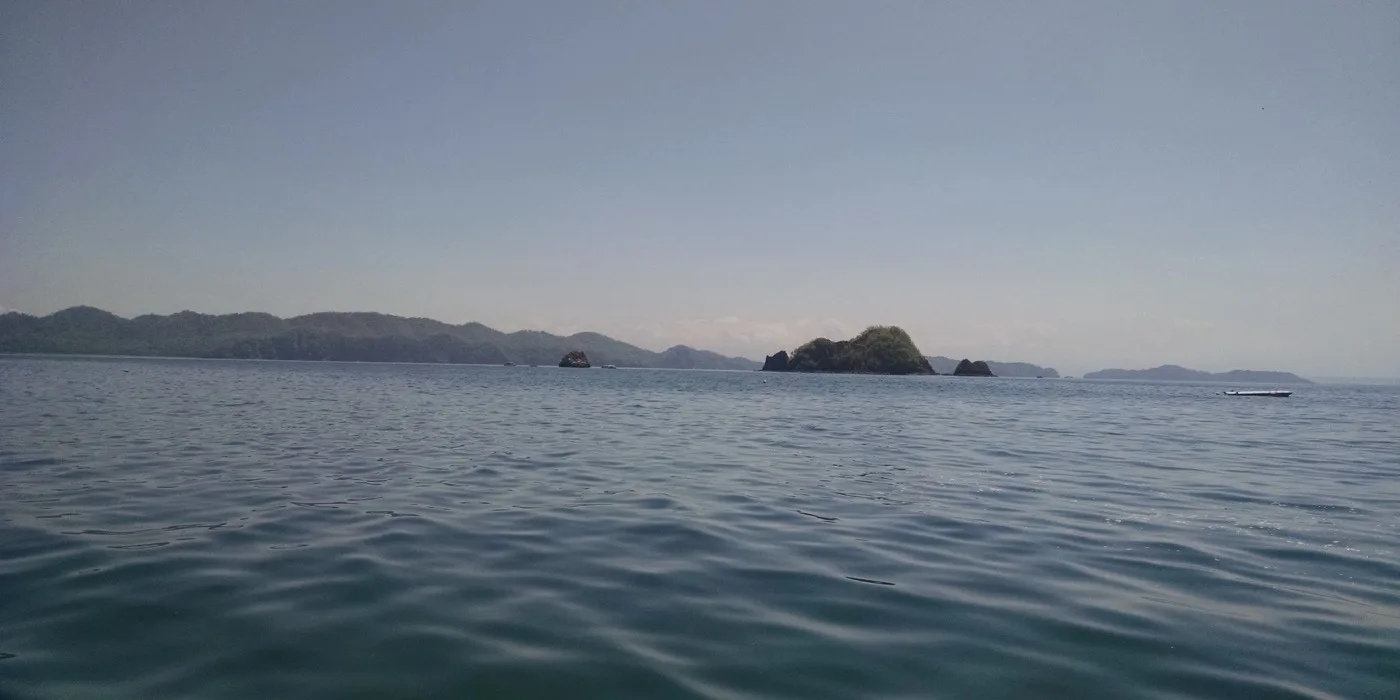
The Catalinas are a scatter of bare volcanic rocks off the Guanacaste coast, roughly between Playa Flamingo and Playas del Coco — Rich Coast Diving puts them “off the Pacific coast near Playas del Coco”. Nobody lives on them. There is no beach to land on. Every trip is a boat trip that anchors off the rock and puts you in the water beside it.
That matters for what you see. The draw is not coral — this is the eastern Pacific, not the Caribbean, and you should not arrive expecting a reef garden. The draw is the rock itself: vertical walls dropping into blue water, and the volume of fish that gather around them. Snorkeling here is about schools and structure rather than colour.
The season nobody mentions: it is windy exactly when it is clearest
This is the part that catches people out, and it comes from putting two ordinary facts side by side.
The dry season in Guanacaste runs roughly December to April, and it is the obvious time to plan a boat day — less rain, less runoff, generally better visibility. The manta season overlaps it almost exactly: November to April, per the dive centre.
But the Papagayo winds run on the same calendar. Las Catalinas describes them: “The Papagayo winds occur mainly between December and April, when cold air masses from North America move south and are funneled through mountain gaps near Nicaragua.” On a strong Papagayo day the crossing is bumpy and the surface is chopped up. Rich Coast Diving refers to “the often challenging surface conditions” at the islands as a reason snorkelers are kept off the manta trips at all.
The practical version
Dry season gives you the clearest water and the worst chop, in the same months. Book a morning departure — the wind usually builds through the day — and treat a cancelled or rerouted trip as a normal outcome rather than an operator letting you down. If you are prone to seasickness, this is not the crossing to test it on.
What a snorkeling day there actually looks like
The standard Catalinas snorkeling trip out of the Flamingo area runs about five hours door to door and gives you two 40-minute sessions in the water, with hotel pick-up from selected areas, gear, a guide and snacks on the boat. It is listed from $115 per person and rates 4.56 from travellers.
Two forty-minute sessions is the number worth holding on to. Most of a five-hour trip is transit, briefing and surface interval. If your mental picture is a whole day in the water, adjust it — and if that sounds thin, a catamaran day out of Flamingo or Tamarindo gives you less time at a serious site but more time on a boat, which for a lot of people is the better trade.
If you want the mantas, you have to dive
There is no snorkeling route to them. The options are a certified two-tank dive at the islands, from $162, or — if you have never dived — an introductory dive with an instructor, which is a different thing again and is covered in its own guide.
And whichever you book, hold the expectation loosely. The dive centre is direct about it: “Manta ray sightings are not guaranteed, as they are wild, pelagic animals.” During the season it says “encounters are frequent”, which is an honest way of putting it and not the same as a promise.
One rule that applies to all of it
Costa Rica’s marine park rules prohibit touching, feeding or harassing marine animals, and that is the standing expectation on any guided marine trip in the country — not only inside a park boundary. A guide who encourages you to touch something is not giving you a better trip.
See Catalina Islands snorkeling & dive tours
Trips run mainly from Playa Flamingo and Playas del Coco. Prices and availability are set by the operator.
Can you snorkel with manta rays at the Catalina Islands?
No. Rich Coast Diving, which runs the manta trips, states that “snorkelers cannot join these trips” because of the depth the mantas are found at and the surface conditions. Seeing them requires diving.
When is manta season at the Catalinas?
November to April, according to the dive centre — “diving with these amazing creatures at Catalinas Islands is only offered from November to April”. Sightings within the season are frequent but not guaranteed.
Is the water rough?
It can be. The Papagayo winds blow mainly December through April and funnel across this stretch of coast, and the same dive centre refers to “often challenging surface conditions” at the islands. Morning departures are usually calmer.
How long do you actually spend in the water?
On the standard trip, two sessions of about 40 minutes each, inside a roughly five-hour day. The rest is transit and surface time.
Is there coral?
Not in the way a Caribbean trip implies. The Catalinas are volcanic rock in the eastern Pacific — the interest is in the walls, the structure and the fish that gather around them rather than in coral gardens.
Sources
Facts in this guide were checked against these references on the dates shown.
Rich Coast Diving (Playas del Coco) — Diving with manta rays at the Catalina Islands — The dive centre that runs the Catalinas manta trips states: “Due to seasonal arrival of the Oceanic Mantas, diving with these amazing creatures at Catalinas Islands is only offered from November to April.” On whether snorkelers can take part: “Due to the deeper depths where manta rays are typically found at the Catalina Islands and the often challenging surface conditions, snorkelers cannot join these trips.” On expectations: “Manta ray sightings are not guaranteed, as they are wild, pelagic animals.” It places the islands “off the Pacific coast near Playas del Coco in Guanacaste”, and notes that during the season “encounters are frequent and the Catalina Islands are known as one of the top manta diving locations in Costa Rica.” (accessed 30 September 2026)
Las Catalinas — The Papagayo winds — “The Papagayo winds occur mainly between December and April, when cold air masses from North America move south and are funneled through mountain gaps near Nicaragua.” (accessed 30 September 2026)
Instituto Meteorológico Nacional de Costa Rica (IMN) — The North Pacific climate pattern for Guanacaste: a long dry season roughly December–April and a wet season concentrated May–November. (accessed 30 September 2026)
SINAC — Parque Nacional Marino Ballena visitor rules — Costa Rica’s marine national park rules prohibit touching, feeding or harassing marine animals — the standard expectation on any guided marine trip in the country. (accessed 30 September 2026)
Plan this trip
Browse the tours that fit what you’ve just read — real operators, real prices, book direct.
Browse snorkel & boat tours